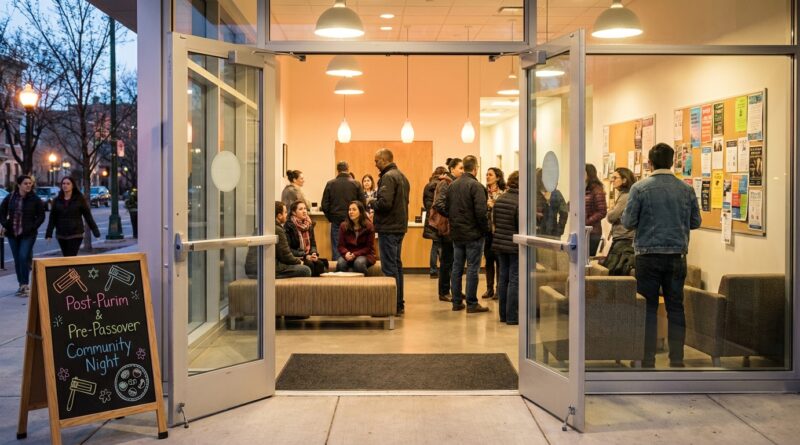
From Purim Carnivals to Passover Prep: How To Join Jewish Life Locally Without Knowing Anyone
Purim can make Jewish life look easy if you are already in. Everyone else sees the costume photos, the crowded carnivals, the smiling group shots, and thinks, great, but how do I actually get in the room? That feeling is real. Looking up synagogue calendars, JCC pages, and Facebook posts can feel less like a welcome and more like being handed a messy stack of tabs. The good news is that the stretch between Purim and Passover is one of the easiest times to join in. Communities are busy, practical, and often actively looking for extra hands and new faces. That means food drives, pre-Passover volunteer days, beginner-friendly classes, family events, and small social gatherings are happening right now. If you are trying to figure out how to find local Jewish community events near me, the trick is not to search more. It is to search smarter, contact one person, and pick one low-pressure event to start.
⚡ In a Hurry? Key Takeaways
- Start with one practical event this week, like a food drive, Passover prep class, or community volunteer shift. These are usually easier for newcomers than a big service.
- Email or message ahead with a simple note asking if it is beginner-friendly and who to look for when you arrive.
- Choose events run by known local groups such as synagogues, JCCs, federations, Chabad houses, or campus and young adult organizations, so you have a clear contact and a safer entry point.
Why this moment is better than it looks
Right after Purim, Jewish communities do not shut down. They shift gears.
The loud public stuff starts giving way to the useful stuff. Matzah sales. Passover workshops. Carnival follow-up events. Chesed projects. Gift shop pop-ups. Family prep days. Intro classes. Volunteer packing events.
That quieter layer is often where actual connection happens.
If you only notice the holiday headline event, you miss the infrastructure underneath it. And that infrastructure is where people learn names, meet staff, and get invited back.
How to find local Jewish community events near me without getting overwhelmed
Use five sources, not fifty
You do not need to scan the whole internet. Start with these:
- Your local JCC website
- Nearby synagogue event calendars
- The local Jewish federation or community council
- Chabad centers
- Jewish young adult groups, Moishe House, Hillel, or PJ Library if they fit your age or stage of life
Open only those tabs. Skip the random event sites unless they link back to a real local organization.
Search for the event type, not just the holiday
People often search “Purim near me” or “Passover event near me” and get giant public listings. Try narrower terms instead:
- Passover prep class
- Jewish volunteer event
- Matzah bake
- Food drive Jewish community
- Young adult Jewish event
- Family Jewish event
That is usually a better way to answer the real question, which is how to find local Jewish community events near me that I can actually walk into.
Pick “participation” over “attendance”
If you feel awkward going alone, do not start with the event where everyone sits with their friends.
Start with the event where people need something done.
Packing food boxes. Sorting donations. Helping with set-up. Joining a beginner discussion. These are easier because you have a role. A role gives you a script without having to invent one.
The best first events for someone who knows nobody
1. Volunteer events
These are often the easiest. You show up, get a task, and meet people in short, natural bursts.
Good signs include words like “all are welcome,” “community service,” “packing,” “collection drive,” and “registration requested.”
2. Pre-Passover learning events
Look for classes with phrases like “intro,” “beginners,” “Passover basics,” or “ask the rabbi.”
People expect questions at these. That makes them much less stressful than events where everyone seems to know what is happening already.
3. Family-friendly fairs and pop-ups
If there is a Judaica sale, holiday market, or community prep fair, those can work well too. They are casual. People come and go. You do not have to understand every ritual detail to belong there.
4. Small Shabbat options
If Shabbat is what you really want, aim for a meal, oneg, newcomer gathering, or smaller service instead of the biggest sanctuary event on the calendar. If that sounds like your lane, this guide on The best way to plug into local Jewish life this Shabbat, even if you feel like an outsider is a smart next read.
The message to send before you go
This is the step most people skip. It matters.
You do not need a perfect email. You just need a tiny human bridge before you arrive.
Use this:
Hi, I saw your event for this week and I am interested in coming. I am pretty new to local Jewish community events and would be coming on my own. Is this a good event for a newcomer, and is there someone I should look for when I arrive? Thanks so much.
That message does three things fast. It tells them you are new. It asks for a simple yes or no. It gives you the chance to walk in already knowing one name.
What to look for in the reply
A good reply will usually include at least one of these:
- A direct welcome
- The name of a host, rabbi, staff member, or volunteer
- What to expect when you arrive
- What to wear or bring
- Whether registration or security check-in is needed
If the response is warm and specific, that is a very good sign.
If there is no reply, do not take it personally. Move to the next event on your list. You are not being rejected. You are filtering for communities that know how to receive new people well.
How to walk in without feeling like everyone is staring at you
Arrive a little early
Ten minutes early is ideal. You are more likely to meet staff before the room fills up.
Use the name you were given
Walk up and say, “Hi, I emailed earlier. I was told to look for Sarah.” That one sentence does a lot of heavy lifting.
Stay long enough to have one real conversation
You do not need to become a regular in one night. The goal is smaller. Learn one person’s name. Ask one question. Find one next step.
Leave with a follow-up
Before you head out, ask, “What is another good event for someone new?” People usually know exactly what to suggest.
Red flags and green flags
Green flags
- Clear event details online
- Simple registration process
- Warm reply to your message
- Someone greeting people at the door
- Visible mix of ages or newcomers
Red flags
- No contact information at all
- Unclear location or last-minute details only
- Very insider-heavy language with no explanation
- Pressure to commit immediately to lots of things
One awkward event does not mean Jewish community is not for you. It may just mean that particular event was built for existing members, not first-timers.
Turn one event into an actual connection
This is the part people miss. Showing up once is good. Converting it into a second point of contact is what starts to make it yours.
After the event, send a short follow-up:
Thanks for welcoming me tonight. I really appreciated it. If there is another beginner-friendly event coming up before Passover, I would love to know about it.
That is how random calendar entries become an actual thread.
And if you are choosing between several options, pick the one most likely to create repeat contact. A weekly class beats a giant festival. A volunteer team beats a one-off lecture. A hosted Shabbat dinner beats standing alone in the back row.
At a Glance: Comparison
| Feature/Aspect | Details | Verdict |
|---|---|---|
| Volunteer event | You have a task, natural conversation starters, and staff usually know who is new. | Best first step for most people |
| Large holiday service or carnival | High energy and public, but easy to feel anonymous if you come alone. | Good once you have one contact |
| Small class or hosted gathering | Lower pressure, easier to ask questions, and more likely to lead to a second invitation. | Excellent for building momentum |
Conclusion
You do not need to crack some secret code to join Jewish life locally. Right now is actually one of the better windows to start. In the last few weeks, communities have moved from big Purim celebrations into the early logistics of Passover, which means food drives, learning circles, gift-shop pop-ups, and carnival follow-ups are happening for a reason. They are built to bring people in. Many people on the edges miss them because they only see the big holiday moments, not the quieter community machinery underneath. So keep it simple. Pick one event this week. Send one short message ahead. Walk in expecting to know at least one name. Then leave with one clear next step. That is how a random listing turns into your first real Jewish contact, and then maybe your second, and then something that starts to feel like yours.