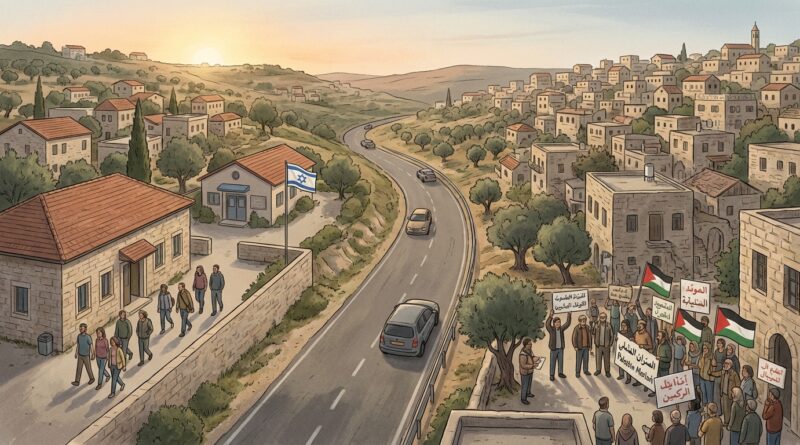
Land Day 2026: The Overlooked March 30th Commemoration That Every Jewish Community Should Be Talking About
You see “Land Day” trending, a protest flyer on campus, or a flood of social posts, and suddenly it feels like everyone else got a briefing you missed. That is frustrating, especially if you are already carrying the stress of antisemitism, war coverage, and the constant feeling that Jewish people are expected to react instantly and perfectly. The good news is that Land Day is not impossible to understand, and you do not need to pick a shouting match to get there. In simple terms, Land Day on March 30 marks the 1976 protests by Arab citizens of Israel against government land expropriations in the Galilee, during which six Arab protesters were killed. For Palestinians, it became a yearly symbol of land, identity, protest, and loss. For many Jews, it shows up not as history first, but as slogans, rallies, and tension. That gap in framing is exactly why a calm explanation matters today.
⚡ In a Hurry? Key Takeaways
- Land Day, observed every March 30, commemorates the 1976 protests over land expropriation in Israel and is now a major symbol in Palestinian activism.
- If you encounter Land Day content today, start by asking what the event is actually commemorating before reacting to slogans or reposts.
- You can stay informed, support Jewish safety, and avoid getting pulled into hostile arguments by using clear language, checking the source, and knowing when to step back.
What is Land Day on March 30?
If you are searching “What is Land Day March 30 explained for Jewish community,” here is the short version.
Land Day refers to March 30, 1976, when Arab citizens of Israel organized strikes and protests against Israeli government plans involving land expropriation in the Galilee. During clashes with Israeli security forces, six Arab citizens were killed, and many others were injured or arrested.
That day became an annual commemoration in Palestinian political life. It is often framed as a day of mourning, resistance, attachment to land, and protest against dispossession.
Over time, Land Day has grown beyond the original events of 1976. Today it can include marches, speeches, social media campaigns, teach-ins, campus protests, and sometimes broader anti-Israel activism. That is one reason many Jews encounter it in a much more charged form than the historical event itself.
Why Jewish communities keep running into Land Day without context
Most Jewish schools, synagogues, and community spaces spend a lot more time teaching Yom HaShoah, Yom Hazikaron, Yom Ha’atzmaut, and the major beats of Israeli and Jewish history. That makes sense. But it also means many Jews first hear about Palestinian commemorations only when those commemorations arrive as confrontation.
So instead of “Here is what this day means to the people marking it,” the experience becomes “Why is there another protest outside Hillel?” or “Why is this all over my feed today?”
That missing middle matters. A lot.
Understanding a day does not mean agreeing with every political use of it. It just means you know what you are looking at. That lowers the emotional temperature and helps you make smarter choices about what to say, where to go, and when to disengage.
What happened in 1976?
The immediate issue
In the mid-1970s, the Israeli government moved ahead with plans tied to land in the Galilee, including expropriation of land affecting Arab communities. Arab leaders and activists called for a general strike and protests.
The protests and deaths
On March 30, 1976, demonstrations took place in several Arab towns. Israeli police and security forces responded, and six Arab citizens of Israel were killed. For Palestinian memory, those deaths became central. The day is not just about property law or planning policy. It is remembered as a moment of collective injury and political awakening.
Why it lasted in public memory
Land is never just land in this conflict. It is home, continuity, identity, belonging, and power. That is true in Jewish history, too. Which is part of why Land Day lands so hard on both sides, even when people are talking past each other.
Why Land Day can feel especially tense for Jews
For many Jews, Land Day is not presented as a historical commemoration with nuance. It often appears folded into maximalist political messaging. Sometimes that messaging criticizes specific Israeli policies. Sometimes it denies Jewish indigeneity, erases Jewish history, or slides into rhetoric that makes Jews on campus or in public spaces feel targeted.
That distinction is important.
A person explaining the history of 1976 is not the same thing as someone using Land Day as a vehicle for harassment. A memorial event is not identical to a protest calling for the end of Jewish self-determination. The label “Land Day” does not tell you which one you are looking at. You have to look at the actual language, organizers, signs, chants, and stated goals.
How to understand Land Day without abandoning your own story
You do not have to flatten Jewish history in order to understand Palestinian memory. And you do not have to ignore Palestinian memory in order to stay rooted in Jewish history.
Try this simple frame.
1. Two things can be emotionally real at once
Palestinians can experience Land Day as a real day of grief and political meaning. Jews can also experience many Land Day events in 2026 as moments of vulnerability, hostility, or erasure.
Those are not mutually exclusive observations.
2. History and activism are not always the same thing
The historical event is one thing. The way it is used today is another. When people confuse the two, conversations get messy fast.
3. Jewish safety is not a side issue
If a Land Day event includes intimidation, support for violence, or language that singles out Jewish students or institutions, that is not something you need to minimize just because the day has historical roots.
What Land Day usually looks like in 2026
Because Land Day falls today, March 30, many Jewish readers will likely encounter it in one of a few ways.
On social media
You may see graphics about “resistance,” “return,” “martyrs,” “settler colonialism,” or land theft. Some posts are basic commemorations. Others are openly ideological. Some are educational. Some are bait.
On campus
Student groups may hold demonstrations, walkouts, die-ins, memorial tables, speeches, or coalition rallies. In some places, these are peaceful and tightly organized. In others, Land Day becomes a launchpad for broader anti-Zionist pressure campaigns.
In the news
Media coverage may connect Land Day to current fighting, tensions in Jerusalem, Arab-Jewish relations inside Israel, or global protest movements. That can blur the original history unless you already know the date’s roots.
Practical do’s and don’ts for Jewish students, young professionals, and community members
Do: Learn the one-sentence explanation
Keep this ready: “Land Day marks the 1976 protests by Arab citizens of Israel over land expropriation, and it has since become an annual symbol in Palestinian political life.”
That sentence alone can steady a conversation.
Do: Check what kind of event it is
Read the flyer. Look at the sponsors. Is this a memorial event, a policy protest, or a rally using eliminationist language? Do not assume. Verify.
Do: Support Jewish peers who feel anxious
If you are on campus or at work, check in with the person who always gets asked to “explain Israel” against their will. Offer company walking to class. Help document harassment if needed. Small acts count.
Do: Know your line
You are allowed to say, “I understand what Land Day commemorates, but I am not going to stand here while people justify violence or target Jews.” That is not ignorance. That is boundaries.
Don’t: Fight every post
Some content is meant to provoke, not inform. You do not have to become the comments section police.
Don’t: Mock the day itself
If your goal is to lower heat and keep credibility, mocking a day of mourning is a bad move. You can disagree with rhetoric or politics without ridiculing loss.
Don’t: Surrender clear language
You can be humane and firm at the same time. If an event crosses into antisemitism, say so plainly.
Useful language if someone asks you about it today
Here are a few grounded ways to respond.
If someone asks, “What is Land Day?”
“Land Day is a Palestinian commemoration of the 1976 protests by Arab citizens of Israel over land expropriation, when six protesters were killed.”
If someone asks, “So should Jews support it?”
“You do not have to endorse every modern political use of Land Day to understand what it commemorates. It depends on the event and the message.”
If someone says, “If you object to this rally, you must not care about Palestinian suffering.”
“I can understand the history behind the day and still object to rhetoric that threatens or erases Jews.”
If someone says, “It is just a memorial, why are Jews upset?”
“Sometimes it is a memorial. Sometimes it includes slogans or behavior that make Jewish students and community members feel unsafe. Context matters.”
What thoughtful Jewish framing looks like
Thoughtful Jewish framing does not mean panic. It does not mean pretending every Palestinian commemoration is automatically an attack. And it does not mean asking Jews to absorb hostility in silence so they can seem “balanced.”
It means telling the truth in full sentences.
Land Day has real historical meaning for Palestinians. It also shows up in Jewish life today mainly through tense public activism. Both facts matter. If we say only one of them, we stop being honest.
The goal is not to win a performance of moral purity. The goal is to help Jews, especially students and young professionals, move through a charged day with context, steadiness, and self-respect.
At a Glance: Comparison
| Feature/Aspect | Details | Verdict |
|---|---|---|
| Historical meaning | Commemorates the 1976 protests by Arab citizens of Israel over land expropriation and the deaths of six protesters. | Important to know, even if you disagree with later political uses. |
| How Jews often encounter it | Through social media campaigns, campus rallies, protest slogans, and tense public actions rather than calm historical education. | Context is essential before reacting. |
| Best response today | Stay informed, separate history from inflammatory activism, support Jewish safety, and avoid being dragged into performative fights. | Calm, clear, and boundary-based is the strongest approach. |
Conclusion
Land Day falls today, March 30, and that means many Jews will run into it whether they went looking or not. The point of understanding it is not to hand over your judgment, your safety, or your connection to Jewish history. It is to replace confusion with context. Land Day is a major annual focus point for Palestinian activism, media coverage, and protests, and many Jews meet it through slogans or demonstrations, not through careful explanation. A calm Jewish framing gives you something better than panic or denial. It gives you language. It gives you nuance. It gives you a way to say, “I understand what this day is, and I also know what crosses a line.” In a week already heavy with Passover prep and regional anxiety, that kind of grounded clarity helps lower the temperature, supports Jewish students and young professionals, and models what it looks like to engage the news as a confident, informed Jewish adult.