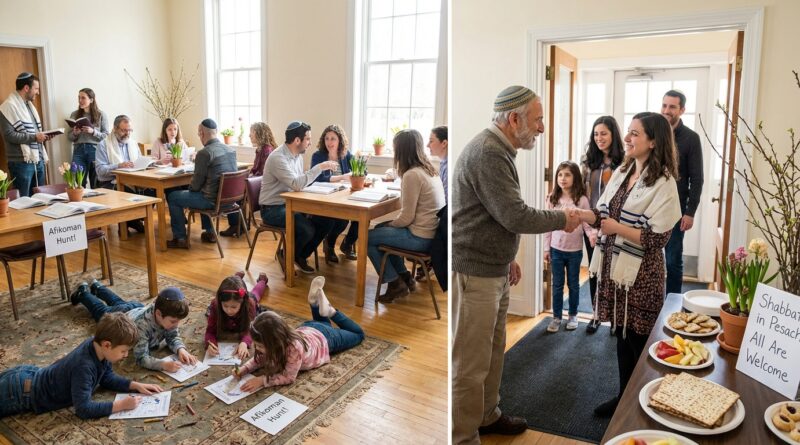
Shabbat In The Middle Of Passover: How Synagogues Are Turning Pesach Shabbat Into A Pop‑Up Community Gathering
It is a weirdly lonely Jewish day if you are not already plugged in. It is Shabbat. It is still Passover. You may want somewhere to go, but not want to cook, host, text ten people, or pretend you know the drill. A lot of people hit this exact wall on the middle Shabbat of Pesach. Students are away from home. Interfaith families are not sure what is open. Travelers do not know which synagogue is welcoming. And plenty of locals assume they missed the moment because nobody invited them directly. The good news is that today, Saturday April 4 2026, is one of those days when synagogues, campus groups, Chabad houses, JCCs, and informal hosts quietly put on extra services, lunches, family activities, and Torah study. The trick is not waiting for it to find you. It is knowing what to search, where to look, and how to tell which gathering is actually open to newcomers.
⚡ In a Hurry? Key Takeaways
- Yes, there are likely Shabbat Passover events near you today, especially morning services, kiddush lunches, family programs, and afternoon study.
- Search using exact phrases like “Shabbat morning,” “Pesach service,” “Passover synagogue,” and “Torah study” plus your city or neighborhood.
- Always check whether the event is open to all, requires registration, or has Passover food rules, security check-in, or walking-distance limits.
Why this particular Shabbat feels different
Regular Shabbat is one thing. Passover is another. Put them together in the middle of the holiday, and the usual plans get scrambled.
Some people are tired of cooking around Passover rules. Some are visiting family and need a local option for a few hours. Some want the feeling of community without committing to a whole seder, full meal, or membership conversation. That is why many synagogues and Jewish groups treat this day almost like a pop-up gathering window.
You will often find a bigger-than-usual mix of options. Traditional services. Family-friendly services. Young adult lunches. Scholar talks. Holiday learning. Community kiddush. Sometimes even outdoor meetups if the weather cooperates and the community has organized one before Shabbat.
What “Shabbat Passover events near me today” usually includes
Shabbat morning services
This is the easiest entry point. Most synagogues that are active for Passover will have a Saturday morning service today. Some are formal and Hebrew-heavy. Others are more relaxed, with clear English guidance and people ready to help first-timers find the right page.
Kiddush or community lunch
If you do not want to cook, this is the golden ticket. Many congregations offer a post-service meal or light lunch that is already Passover-friendly. Search for words like “Kiddush lunch,” “community luncheon,” or “Pesach kiddush.”
Family and kids programs
If you have children, look for “family service,” “tot Shabbat,” “Passover family program,” or “children’s activities.” These events are often timed to overlap with the main service so parents can join in without managing a whole day alone.
Torah study or holiday learning
Not everyone wants a full service. Some people want one hour, one table, one conversation. That is where Torah study, lunch-and-learn style sessions, or holiday classes come in. Search “Torah study Passover” with your city name.
Traveler-friendly or walk-in options
Chabad houses, campus Hillels, and some larger synagogues are especially good for this. They are used to guests showing up during holiday periods and often spell out the basics clearly on their sites.
How synagogues are turning today into a pop-up community moment
The shift is not always flashy. It is practical.
Instead of expecting everyone to know the right people, many communities now post same-day schedules on their websites, Instagram pages, and email newsletters. They know that a lot of people decide late. They know some visitors are in town just for the holiday weekend. They know many Jews feel interested but hesitant.
So what happens? A synagogue that feels closed-off on an ordinary week may be very open today. A congregation that usually serves only members may advertise “all are welcome” for a holiday kiddush. A rabbi may add a short teaching after services because there are more guests than usual. A family program may be built specifically for people who did not host or attend a big meal.
It is less about grand reinvention and more about lowering the entry barrier for one day.
How to search smarter right now
If you only type “Passover events” you will get stale listings, old seders, or general holiday calendars. You need more specific search terms.
Best search phrases to use
Try these one by one:
- Shabbat Passover events near me today
- Shabbat morning service Passover [your city]
- Pesach service today [your neighborhood]
- Torah study Passover [your city]
- Synagogue kiddush today [your city]
- Family Shabbat Passover program [your city]
- Chabad Passover Shabbat [your city]
- Hillel Passover Shabbat [your campus or city]
Where to look after Google
Google is step one, not the whole job. Check:
- Synagogue websites, especially the calendar or “worship” page
- Instagram bios and stories for congregations and rabbis
- JCC event calendars
- Chabad.org local center listings
- Hillel or Jewish student group pages
- Federation community calendars
- Facebook pages of local congregations
Words that signal “newcomers welcome”
Look for phrases like “all are welcome,” “open to the community,” “guests welcome,” “community lunch,” or “no membership required.” Those are your green lights.
What to check before you go
Security and entry rules
Many synagogues have security at the door. That is normal. Some require ID. Some ask for advance registration. If the listing mentions security, arrive a little early and bring identification.
Food and Passover details
If a meal is offered, make sure it is specifically for Passover. Do not assume every “community lunch” works for your own observance level. Some communities follow stricter Passover food practices than others.
Walking and timing
On Shabbat, some attendees avoid driving or using phones. Even if that is not your practice, it affects timing. If you need directions or want to call ahead, do it before leaving.
What to wear
You do not need a costume version of “synagogue clothes.” Clean, respectful, simple is fine. If you are worried, business-casual usually works in most settings.
Best options by type of reader
If you are in an interfaith family
Look for family services, beginner-friendly synagogues, Reform congregations, JCC programs, and community lunches. These often do the best job of explaining what is happening without making anyone feel out of place.
If you are a student
Search Hillel, Chabad on Campus, or “young adult Shabbat lunch” in your city. Students often think everything is closed if campus is quiet, but holiday weekends can bring extra gatherings.
If you are traveling
Start with Chabad, larger downtown synagogues, and hotels near Jewish neighborhoods. Search “[city] synagogue visitors welcome Passover.” Many communities are used to out-of-towners during holiday periods.
If you are local but disconnected
You may feel awkward showing up after years away. That is common. Choose the place with the clearest public schedule and the least mystery. A simple “Shabbat morning service followed by kiddush” is often easier than a highly themed event.
If you feel nervous about going alone
That feeling makes sense. Walking into any house of worship by yourself can feel like joining a movie halfway through.
Here is the simple approach. Pick one event. Not three. One. Choose the one with the clearest start time and public location. Arrive ten minutes early. Tell the first greeter, “Hi, I’m visiting and wanted to join for Shabbat during Passover.” That one sentence does a lot of work. It tells people you are not lost, not crashing, and not looking for a private invitation.
Most communities will meet you halfway once you say that.
How to tell if an event is the right fit fast
You do not need to decode every denomination before breakfast. Use these quick clues:
- If the site has lots of guest information, it is likely newcomer-friendly.
- If there is a posted service time and kiddush note, it is likely active and organized today.
- If there is zero mention of visitors, registration, or schedule, call ahead before Shabbat if possible, or choose another option.
- If the listing mentions children, learning, or lunch, it is often more social and less intimidating.
One realistic game plan for today
If you are reading this in the morning and feel behind, you are not behind.
Search your city plus “Shabbat morning service Passover.” Open three results. Skip the one with no details. Pick the congregation with a clear time, address, and some sign that guests are expected. Go for the service or just the kiddush if that is what is publicly offered. Stay one hour if that is all you can manage.
That still counts. It more than counts. It is how vague holiday longing turns into an actual human day.
At a Glance: Comparison
| Feature/Aspect | Details | Verdict |
|---|---|---|
| Best first stop | Shabbat morning service with a listed kiddush or lunch afterward | Best mix of prayer, food, and easy conversation |
| Best search method | Use exact terms like “Pesach service today,” “Shabbat morning,” and “Torah study” plus your city | More accurate than broad “Passover events” searches |
| Best option for nervous newcomers | Public synagogues, Chabad houses, JCC programs, and family-friendly events with “all are welcome” wording | Lowest-friction way to join Jewish life today |
Conclusion
Today, Saturday April 4 2026, is one of those oddly perfect chances to reconnect. Because it is both Shabbat and the middle of Passover, there is a real bump in local services, family programs, and pop-up community gatherings that many people only hear about after the fact. You do not need to host. You do not need to know everyone. You do not need to have planned this a week ago. If you are an interfaith family, a student, a traveler, or just someone who feels disconnected, one smart search for “Shabbat morning,” “Pesach service,” or “Torah study” in your city can lead to one real-world Jewish touchpoint today. And sometimes one hour in the right room is all it takes to stop feeling like the holiday is happening somewhere else without you.