Yom HaShoah 2026: Turning Holocaust Remembrance Into A 24‑Hour Global Jewish Teach‑In
You know Yom HaShoah is next week. You want to do more than light a candle, repost a quote, and move on. But then the flood starts. Museum livestreams. Campus vigils. Testimony clips. Panel talks. Prayer services. Social posts that feel sincere, and others that feel loud or political or strangely performative. It is a lot. That overload can leave good people stuck, and when you are stuck, you often do nothing different at all. The better approach for Yom HaShoah 2026 community events is not to do everything. It is to choose a few meaningful moments and shape them into a shared experience people can actually absorb. Think less like a content consumer and more like a careful host. Pick one testimony, one communal ritual, and one conversation. That is enough to create a day, or evening, that feels real, grounded, and Jewish.
⚡ In a Hurry? Key Takeaways
- For Yom HaShoah 2026 community events, choose 2 to 4 high-impact elements instead of trying to attend everything.
- Use a simple mix: one testimony, one ritual act, and one small discussion with clear start and end times.
- Keep it emotionally safe. Give people a way to step back, ask questions, and participate without pressure.
Why Yom HaShoah can feel harder to plan than it should
There is a quiet pressure around Holocaust remembrance. People want to get it right. They do not want to be shallow, dramatic, or uninformed. So they hesitate.
That hesitation makes sense. Yom HaShoah is not a regular awareness day. It asks for memory, dignity, and care. It also arrives in a media environment that can flatten everything into clips, arguments, and slogans.
If you are planning something for family, a school group, a synagogue circle, a campus apartment, or just a few friends on Zoom, your job is not to create the biggest program. Your job is to create a container people can enter honestly.
The simple framework: 3 parts, 24 hours, no overload
1. Choose one anchor event
Start with one central experience. This could be a museum livestream, a local memorial ceremony, a survivor testimony screening, or a community reading of names.
Ask three basic questions:
- Is it credible and well-organized?
- Is it emotionally appropriate for the people I am inviting?
- Does it leave room for reflection, not just consumption?
If the answer is yes, that becomes your anchor. Everything else should support it, not compete with it.
2. Add one ritual act
People remember what they do, not only what they watch. Add one simple practice. Light memorial candles. Read Psalm 23 or El Malei Rachamim. Observe a minute of silence. Invite people to write down the name of a victim, survivor, or family member they want to honor.
This is what turns a stream into a commemoration.
3. End with one guided conversation
Do not assume people will know what to say after a heavy program. Give them structure. Keep it short. Twenty minutes is enough.
Try these prompts:
- What part of tonight stayed with you?
- What did you learn that felt personal, not just historical?
- What does Jewish remembrance ask of us now?
That last question matters. It keeps Yom HaShoah from becoming a passive ritual.
What to skip
You do not need a packed agenda. In fact, too much can numb people. If you stack five videos, a panel, a prayer service, and a discussion into one sitting, most guests will shut down by the halfway point.
Skip the urge to prove seriousness by making the program longer. Depth beats volume.
Also skip random social media clips unless you know the source. This is not the day to rely on whatever your feed serves up.
How to build a meaningful Yom HaShoah 2026 community event at home or in a small group
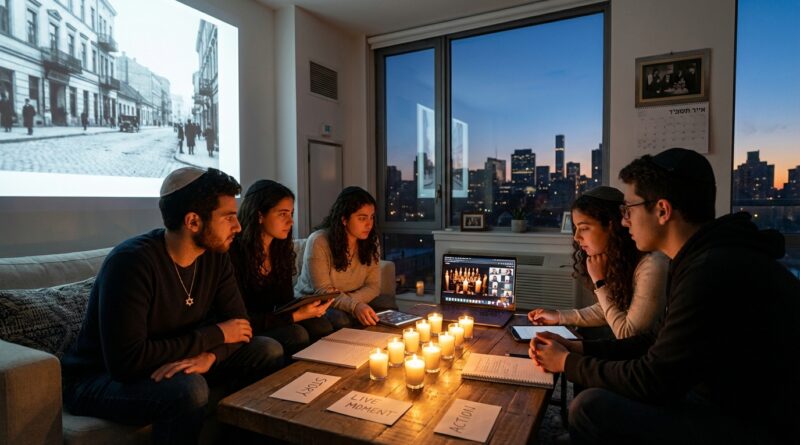
Option A: The 45-minute living room format
- 5 minutes. Welcome and set intention.
- 15 minutes. Watch one survivor testimony clip or museum segment.
- 10 minutes. Candle lighting and a short reading.
- 15 minutes. Guided discussion.
This works well for families, neighbors, and friend groups who want something intimate and manageable.
Option B: The campus or young adult format
- Meet at a visible but calm location.
- Open with a short explanation of Yom HaShoah.
- Share one testimony excerpt or diary passage.
- Hold a candlelight walk or silent stand.
- Close with resources for further learning and support.
On campuses especially, tone matters. Keep the focus on remembrance, not spectacle. If your group is already navigating tense public conversations, it may help to read related context like Land Day 2026: The Overlooked March 30th Commemoration That Every Jewish Community Should Be Talking About. Not because the two days are the same, but because communities benefit from understanding how memorial dates can become confused, politicized, or reduced to slogans online.
Option C: The Zoom teach-in
- Send an agenda in advance.
- Keep cameras optional.
- Use one host and one discussion guide.
- Share a follow-up email with readings, recordings, and support resources.
This format is especially good for people who want to take part but are not connected to a synagogue or Jewish institution.
How to choose the right content without becoming a curator of trauma
This part is important. Yom HaShoah should involve witness, but not emotional overload for its own sake.
When choosing testimony or educational material, look for pieces that are:
- Historically grounded
- Age-appropriate
- Specific, not sensational
- Presented with context
One strong testimony is often more moving than a playlist of horrors. People need enough space to hear a human voice, not just absorb facts or shock.
Make it feel Jewish, not generic
A lot of public Holocaust content uses the language of “never forget,” but leaves out Jewish life, Jewish loss, and Jewish continuity. You can correct that gently.
Use Hebrew and English if that fits your group. Mention that Yom HaShoah is part of the Jewish calendar, not just the international remembrance calendar. Include a prayer, a psalm, or a text about memory. Name the destruction of Jewish communities, and also the survival of Jewish learning, family, and practice.
That balance matters. Remembrance is not only about death. It is also about refusing erasure.
How to keep the gathering emotionally safe
Not everyone walks into Yom HaShoah with the same background. Some have survivor family stories. Some are new to Jewish community. Some are carrying current fears that get stirred up by Holocaust material.
So say a few things out loud at the start:
- You are free to step out if needed.
- You do not have to speak.
- Questions are welcome.
- We are here to remember with care, not debate people’s pain.
That kind of framing changes the whole room.
If you only have one hour this year, do this
Here is the simplest solid plan for Yom HaShoah 2026 community events:
- Choose one trusted livestream or local memorial.
- Invite 3 to 10 people, in person or online.
- Light candles together.
- Watch the program.
- End with one round of reflection.
That is not “small.” That is real. Community memory is built exactly this way, one thoughtful room at a time.
At a Glance: Comparison
| Feature/Aspect | Details | Verdict |
|---|---|---|
| Large public livestream | Strong speakers, broad reach, easy to access, but can feel passive without local follow-up. | Best as the anchor, not the whole plan |
| Small home or Zoom gathering | More personal, easier discussion, less intimidating for people outside formal institutions. | Best for meaningful participation |
| Packed multi-event schedule | Can create overload, emotional fatigue, and shallow engagement. | Usually skip or cut down |
Conclusion
Yom HaShoah begins on the evening of April 13, 2026, and plans are being finalized right now across Jewish communities, from campus vigils and museum livestreams to grassroots Zoom gatherings and youth-led candlelight walks. You do not need to master all of it. You just need to choose a few high-impact experiences and hold them with care. One testimony. One ritual. One conversation. That simple framework can help you move from consuming grief to building thoughtful communal memory. In a noisy, politicized, often shallow online culture, that is not a small thing. It is a way of showing up that feels grounded, emotionally safe, and truly Jewish, even if you are doing it outside any formal institution. Start where you are. Invite a few people in. Make remembrance something shared, not scrolled past.