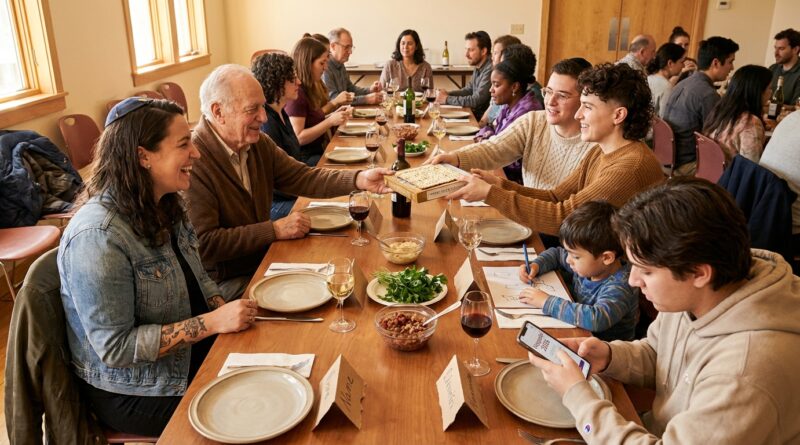
Your First Community Seder: How Local Passover Events Are Quietly Transforming Jewish Connection in 2026
You are not weird for feeling stuck here. “Community seder” sounds simple until you actually try to pick one. Then suddenly you are staring at signup forms, synagogue websites, Instagram flyers and words like “traditional,” “musical,” “young professionals,” or “family friendly,” trying to guess where you will fit. Maybe you are Jewish but rusty. Maybe you are interfaith. Maybe you just do not want to spend another holiday alone with a supermarket macaron box and a PDF Haggadah.
The good news is that finding the right fit in 2026 is less about knowing the “right” kind of Judaism and more about knowing what kind of room you want to walk into. Local seders have changed. Some are formal and prayer-heavy. Some are potluck-style and relaxed. Some are built for first-timers, students, queer Jews, young families, Russian speakers, Israelis abroad, or neighbors who are simply curious. If you have been searching how to find a community seder near me, the trick is not just finding a seat. It is finding a table where you can exhale.
⚡ In a Hurry? Key Takeaways
- The best way to find a community seder near you is to check local synagogues, JCCs, Hillel groups, Moishe Houses, Chabad centers, Facebook groups, and Jewish federation event pages, then message organizers directly with a few simple questions.
- Before you sign up, ask about vibe, length, cost, food, accessibility, kids, interfaith welcome, and whether first-timers are expected. That one step cuts awkwardness fast.
- If you are nervous, say so. Most organizers are actively trying to fill seats and welcome newcomers, and many can match you with a host or greeter.
Why community seders feel bigger in 2026
Something has shifted. More people want Jewish connection, but not always in the old automatic way of “I go where my family goes.” People move cities. Families are smaller. More households are interfaith. Students are far from home. Some people are coming back to Jewish life after years away. Others are stepping in for the first time.
That is why community seders matter right now. They are not just holiday meals. They are one of the easiest on-ramps into Jewish life because they mix ritual, food, storytelling, singing, and plain old sitting at a table with other humans.
Organizers know this too. Many local groups are trying hard to welcome people who do not already have a built-in seat. The problem is that their event pages often assume you already speak the language. So let’s translate.
How to find a community seder near me without going in circles
Start with the places most likely to have open seats
If you are searching how to find a community seder near me, check these in roughly this order:
- Local JCCs. Often the easiest entry point. Usually broad, community-minded, and less intimidating than people expect.
- Synagogues. Reform, Conservative, Reconstructionist, Orthodox and independent shuls may all host seders or know members who do.
- Chabad. Very common source of public seders, especially if you need a welcoming option fast.
- Hillel and campus Jewish groups. Great for students, grad students, and often young adults nearby.
- Moishe House and grassroots collectives. Best for younger adults looking for a casual, social feel.
- Jewish federation calendars. Good for citywide event roundups and referral lists.
- Local Facebook groups, Instagram, Eventbrite, and Meetup. Search your city plus “Passover,” “seder,” or “Jewish young adults.”
Use simple search phrases: “Passover seder Boston,” “community seder near me,” “interfaith seder Chicago,” “family Passover event Atlanta,” or “first night seder open to public Los Angeles.”
Do not just read the event page. Message someone.
This is the step people skip. It matters most.
A quick email or DM can tell you more than a polished flyer ever will. Ask:
- Is this seder good for someone coming alone?
- Would it feel comfortable for a first-timer or someone returning after a long break?
- What is the overall vibe, traditional, casual, musical, family-heavy, discussion-based?
- How long does it usually run?
- Is dinner provided, potluck, or bring-your-own?
- Are interfaith partners or non-Jewish guests welcome?
- Is the space accessible?
- Is there a greeter or someone who can help me settle in?
If the reply is warm and specific, that is a good sign. If it is vague, delayed, or feels like you are pulling teeth, trust that signal too.
What the labels usually mean, in plain English
“Traditional”
Usually means more Hebrew, more structure, and more of the Haggadah before dinner. Not bad. Just longer, and often less free-form.
“Community”
Could mean almost anything. It often signals that the event is open beyond members, but you still need to ask who tends to attend.
“Family friendly”
Great if you have kids. Less great if you want a quiet, reflective night. Expect movement, noise, and a shorter attention span in the room.
“Young professionals”
Usually means 20s and 30s, social, lower barrier, and often more casual dress and conversation.
“Interfaith welcome”
A good sign if you are bringing a partner or are not sure how your background will land. It usually means the host has thought about newcomers on purpose.
“Liberal,” “progressive,” or “inclusive” seder
Often means more English, more explanation, possible social justice themes, and flexibility around who leads and how ritual is handled.
How to choose the right seder for you
Forget trying to pick the “best” seder. Pick the one that matches your actual comfort level.
If you want the least intimidating option
Choose a JCC seder, a synagogue explicitly advertising newcomers, or a public Chabad seder where staff are used to people walking in with questions.
If you want meaning but not too much performance pressure
Look for words like “participatory,” “explained,” “welcome to all backgrounds,” or “community potluck.” These often leave more room to just be present.
If you are in your 20s or 30s and do not want to be the only unattached person there
Try Moishe House, Hillel alumni networks, Jewish young adult groups, or a grassroots seder hosted in a home or shared space.
If you are bringing a non-Jewish partner
Do not assume every seder handles this equally well. Ask directly. A good host will answer without making it weird.
If you need disability access, food clarity, or sensory ease
Ask before registering. Is the space wheelchair accessible? Is there a quiet area? Are allergies handled seriously? Is the meal seated or buffet? Good organizers will be glad you asked.
What to say when you reach out
You do not need a polished message. Try this:
“Hi, I’m looking for a seder this year and saw your event. I’d likely be coming solo and I’m hoping for something welcoming to someone who is a bit out of practice. Could you tell me a little about the vibe and whether this would be a good fit?”
Or this:
“Hi, my partner and I are interested in attending. I’m Jewish, they’re not, and we’re looking for a seder where we won’t feel out of place. Is your event open to interfaith couples?”
That is enough. Really.
How to show up without feeling awkward
Arrive a little early
Ten to fifteen minutes early is ideal. You can find your seat before the room gets busy, and you are more likely to meet the host when they still have a free second.
Tell one person it is your first time there
This works like magic. Most awkwardness fades once one human knows you are new. They can point you to coats, bathrooms, food, and the right moment to sit down.
Bring one useful thing
Even if the event says nothing is needed, bringing wine, flowers, kosher-for-Passover dessert, or a simple thank-you note gives you an easy social opening. If it is in a private home, ask first.
Do not worry about “performing” Judaism correctly
You can follow along loosely. Stand when people stand. Sit when they sit. If a song starts and you do not know it, smile and listen. Nobody sensible expects a first-timer to suddenly become the cantor.
Questions people are quietly afraid to ask
“What if I do not know much Hebrew?”
That is normal. Many people at community seders know only bits and pieces. Plenty of modern Haggadot include transliteration and English.
“What if I do not keep kosher?”
You do not need to be kosher-observant to attend most public seders. Just respect the host’s food rules. If you are bringing something, ask what is appropriate.
“What if I am not Jewish but my partner is?”
You can often attend, but ask first. Many communities genuinely welcome partners and friends. It is better to know the tone ahead of time than to guess.
“What if I get there and it is not my crowd?”
You are allowed to learn from one not-perfect experience. One seder is not all Jewish life. If it feels too formal, too loud, too long, or too insider-heavy, try a different type next year, or even the second night.
Why these local events are quietly changing Jewish connection
Community seders are doing something smart that many institutions have struggled with. They give people a specific reason to come, a script to follow, food to share, and a built-in topic of conversation. That lowers the social friction.
For people on the edge of Jewish life, this can be the first real point of re-entry. For organizers, one filled seat can become a future volunteer, member, donor, host, or just a familiar face who comes back. That sounds small. It is not. Communities are built exactly this way, one table at a time.
That is why your RSVP matters more than it seems. You are not crashing someone else’s tradition. In many cases, you are the person they have been hoping would actually come.
Red flags to notice before you commit
- No clear contact person.
- Registration page is confusing about cost, food, or location.
- Questions about accessibility or newcomers get ignored.
- The event is marketed as “for everyone” but replies make you feel like a burden.
- You cannot tell whether it is a private home, institution, or public venue.
You are not being picky. You are checking for basic hospitality.
Best-case move if you still feel frozen
Pick two options today. Send both a note. Go with the one that replies like a human.
That is often the difference. Not the denomination. Not the branding. Not whether the flyer looked cooler. The best first seder is usually the one where somebody makes it easier for you to walk through the door.
At a Glance: Comparison
| Feature/Aspect | Details | Verdict |
|---|---|---|
| Public synagogue or JCC seder | Usually organized, clearly timed, and easier for first-timers to understand. Can be more formal depending on the community. | Best all-around starting point for most people. |
| Grassroots or young adult home seder | More casual, social, and often easier for solo attendees in their 20s and 30s. Details may be less polished. | Great if you want warmth and less formality. |
| Chabad or outreach-focused seder | Often very welcoming and used to newcomers. May be more traditional in ritual and religious framing. | Excellent if you need a seat fast and want clear hosting. |
Conclusion
If you have been hesitating, this is your nudge. In the days before Passover, synagogues, JCCs, student groups, and grassroots hosts are trying to finalize signups, hospitality lists, and seating plans. A lot of people want to come but feel unsure how to begin. At the very same time, organizers are hoping the right newcomers will find them. So send the message. Ask the basic questions. Choose the room that sounds kind, not perfect. A first community seder does not need to be flawless to matter. It just needs to get you to a table where you are welcomed, fed, and included in the story. That is the bridge. And this year, it is still very much within reach.