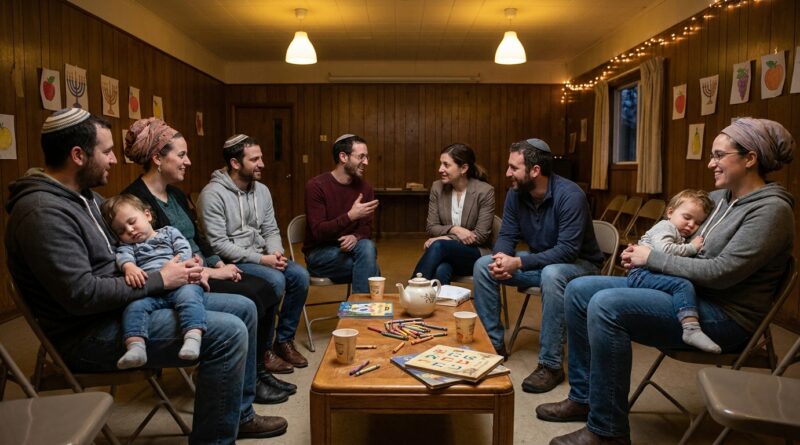
Tonight’s Post‑Holiday Jewish Parenting Circles: The Gentle Meetups Turning ‘I’m Carrying All This Alone’ into Shared Stories and Support
You can love the fall holidays and still feel completely flattened by them. That is where a lot of Jewish parents are tonight. The meals happened. The clothes were found, mostly. The kids made it through services, sukkah dinners, late bedtimes, sugar, guests, and big feelings. Then October lands. Suddenly there is laundry, work, school forms, overtired children, and a strange emotional thud nobody warned you about. For many families, this is the exact moment a Jewish parenting support group after the holidays can matter most. Not because you need one more obligation, but because you need one room where nobody has to explain why a beautiful season can also leave you wrung out. These new parenting circles, pop-up meetups, and low-pressure learning groups are giving adults a rare gift. A chance to exhale, compare notes, and remember that what felt chaotic or lonely at home was not happening only to them.
⚡ In a Hurry? Key Takeaways
- Tonight’s post-holiday Jewish parenting circles are meant to help parents process the emotional and practical crash that often comes right after Tishrei.
- If you go, expect a gentle, low-pressure room where you can listen, share one small thing, and leave with at least one useful connection or idea.
- These groups are support spaces, not therapy. If you are in deep distress, look for a licensed mental health provider or crisis support in your area.
Why tonight feels harder than people admit
The problem is not that the holidays were bad. Often, they were meaningful. Even lovely. The problem is that they asked a lot from parents all at once.
You were feeding people, managing overstimulated kids, handling synagogue logistics, fielding family expectations, trying to create memory-worthy moments, and maybe carrying your own spiritual hopes too. That is a lot of tabs open in one human brain.
Then the calendar flips, and everyone acts like normal life should restart instantly.
It usually does not.
Kids can come out of the chagim dysregulated. Sleep gets weird. School resistance spikes. Parents feel snappy, flat, or teary for reasons they cannot quite name. A Jewish parenting support group after the holidays helps because it gives this experience a name and a place. That alone can lower the temperature.
What these parenting circles actually are
Do not picture a formal program with fluorescent lights and forced sharing. Many of the best ones are much gentler than that.
Small, human, and easy to enter
Some are hosted by synagogues. Some by JCCs, Jewish family service groups, or independent educators. Others happen in living rooms, playground corners, or over tea after school drop-off.
The format varies, but the goal is usually the same. Help parents talk honestly about what the holiday season felt like in real family life.
Mental-health-aware, but not clinical
A lot of these meetups are being shaped by people who understand burnout, nervous system overload, and the fact that parenting stress does not disappear just because a season is meaningful. That means you may hear prompts like:
- What surprised you about your child this holiday season?
- What part of the holidays felt nourishing, and what part felt draining?
- What routine is hardest to rebuild this week?
That sounds simple. It is. And that is the point.
What to expect if you walk in alone
This is one of the biggest worries. People imagine everyone else already knows each other, or that they will have to spill their guts to strangers.
Usually, neither is true.
You are allowed to just listen
Most good circles make room for different comfort levels. You do not need a polished story. You do not need a crisis. You can say, “I’m mostly tired and my kids are all over the place,” and that is enough.
No one expects you to be the “good Jewish parent” here
This matters more than it sounds. In many Jewish spaces, parents can quietly feel pressure to be grateful, engaged, community-minded, and spiritually present all at once. A healthy support circle makes room for mixed feelings. You can say the holidays were beautiful and exhausting. You can admit your child hated services. You can confess that you are still finding etrog stickers in the car and feel irrationally angry about it.
You may leave with practical help, not just emotional relief
The best groups produce useful sentences like:
- “Oh, your kid melted down after Simchat Torah too?”
- “Here is how we reset bedtime this week.”
- “There’s a Sunday parent coffee at our shul.”
- “I can text you the name of a great family therapist.”
Sometimes support is not one huge breakthrough. Sometimes it is one less lonely Tuesday.
How to find a Jewish parenting support group after the holidays
If you want one tonight or this week, cast a wider net than you think.
Start with the obvious places
- Your synagogue email list or events page
- The local JCC calendar
- Jewish Family Service or community mental health organizations
- Jewish preschools and day schools
- Neighborhood parent WhatsApp and Facebook groups
Use plain language when you search
Try terms like “Jewish parenting support group after the holidays,” “post Tishrei parent circle,” “Jewish moms group October,” “Jewish dads support meetup,” or “family reset after the chagim.”
Ask one direct question
If nothing obvious comes up, message a rabbi, educator, or school parent coordinator and ask: “Is there any parent gathering this week for people coming down from the holiday season?”
You do not need the perfect wording. You are probably naming a need they have already noticed.
What makes a good circle worth your time
Not every group is a fit. A few signs help.
Look for warmth, not performance
A good group does not feel like another room where you have to impress people. It should feel structured enough to be safe, but relaxed enough to be honest.
Look for clear boundaries
The host should explain basics like confidentiality, respect, and whether this is discussion-based, text-based, or a mix of both.
Look for practical realism
If a group talks only in big ideas and never about bedtime disasters, sibling fights, school re-entry, or emotional overload, it may not be the right room for this week.
If your city has nothing yet, start something tiny
You do not need a grant, a logo, or a huge plan. You need three people, a time, and permission to keep it simple.
A starter version that actually works
- Invite 4 to 8 parents.
- Pick one hour. Keep it short.
- Meet in a living room, park, or synagogue lounge.
- Offer tea, seltzer, and something easy to nibble.
- Open with one question: “How did the holidays really land in your house?”
Use a light structure
Simple works best:
- Five minutes to settle in.
- Twenty minutes of check-ins.
- Twenty minutes on one topic, like routine reset or kids who were overstimulated.
- Ten minutes for resource-sharing.
- Five minutes to close.
Do not try to solve everything
Your job is not to become everyone’s counselor. Your job is to create one decent container where people can be human together.
Who especially may need this right now
Truthfully, almost any parent could. But some families are carrying extra weight this week.
- Parents of neurodivergent kids who found the holiday shifts especially hard
- Single parents who had to make all the logistics work alone
- Interfaith families navigating a lot of visible and invisible expectations
- Parents new to Jewish ritual life who are still learning the rhythms
- Parents who hosted a lot and are now crashing
- Anyone dealing with grief, infertility, estrangement, or financial stress under the surface of “holiday joy”
These are not edge cases. They are normal parts of real community life.
When support needs to be more than a circle
A meetup can help a lot. It can also reveal that someone needs more support than a peer gathering can give.
If you or another parent is showing signs of severe anxiety, depression, panic, rage that feels unmanageable, substance misuse, or complete inability to function, it is time to seek professional help. Jewish Family Service agencies, therapists who know family systems, and parent support counselors can be a better next step.
That is not failure. That is good triage.
Why this moment matters more than it seems
Post-holiday parenting support is not just a nice add-on. It can be the difference between a hard week that softens and a hard season that turns into isolation.
When parents compare notes, they often discover that what felt like private failure was just common strain. That shift matters. It lowers shame. It opens options. It helps people ask for help earlier, before everyone is running on fumes.
And there is something very Jewish about that. Not the burnout part. The gathering part. The part where people sit down, tell the truth, and make room for one another.
At a Glance: Comparison
| Feature/Aspect | Details | Verdict |
|---|---|---|
| Best format for tired parents | Small, one-hour circles with light facilitation, clear prompts, and no pressure to overshare | Most likely to feel doable and helpful |
| What you gain | Emotional relief, practical parenting ideas, and local connections for the weeks ahead | High value for low time investment |
| Limitations | Peer groups are not a substitute for therapy, crisis care, or long-term mental health treatment | Excellent first step, not the whole support system |
Conclusion
In the 24 hours after the fall chagim wrap, Jewish parents are often left carrying a heavy, invisible load. Kids are overstimulated. Routines are blown up. Work is piled high. And there is very little space to process what just happened in our homes and hearts. That is why tonight’s emerging parenting circles, mental-health-aware meetups, and gentle learning groups matter so much. They give adults a place to exhale together, compare notes on how their kids actually experienced the holidays, and rebuild a sense of village before burnout hardens into isolation. If your city has one, consider going, even if you arrive tired and say very little. If your city has none, start small and invite a few people over. October does not have to be the lonely crash after a meaningful season. It can be the month you quietly find your people.