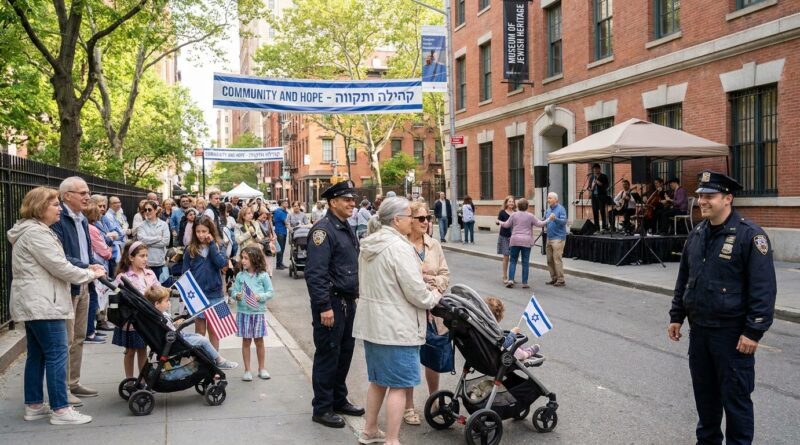
Today’s Israel Day Parades And Family Festivals: The Street‑Level Moments Turning ‘Jewish Pride Is Too Political Right Now’ Into Simple, Shared Joy
If your feed today feels like one long fight about the Israel Day Parade, you are not imagining it. A lot of Jews are tired. Tired of security talk. Tired of boycott talk. Tired of feeling like even showing up for a song, a stroller walk, or a blue-and-white balloon somehow has to become a statement. If what you want is much smaller and much more human, one decent hour with your kids, one friendly crowd, one Hebrew chorus you do not have to defend, that is still possible. The better way to think about Israel Day Parade 2026 Jewish community events today is not as one giant argument, but as a set of real places where people are gathering in public, in museums, and in parks. New York’s Celebrate Israel parade, the Mishpachah Festival at the Museum of Jewish Heritage, and local family programs in communities like Seattle all offer something the internet cannot. Actual presence. Actual faces. Actual joy.
⚡ In a Hurry? Key Takeaways
- Yes, there are still low-pressure ways to take part today, even if you do not want the biggest, loudest version of the parade.
- Pick one simple option before the day ends: stand along the route for 20 minutes, visit an indoor family festival, or join a local Jewish park or community program.
- If safety worries are stopping you, choose events with clear security, daylight hours, and easy exit options so the day feels manageable, not overwhelming.
What people are really looking for today
Most people are not asking for a perfect political answer. They are asking a much more practical question. Is there somewhere I can go today that feels Jewish, warm, and normal?
That matters. Especially now.
For plenty of families, “showing up” does not mean marching for hours or making a social media post. It means watching a few floats go by. Buying your child a snack. Hearing Hebrew music in public and feeling your shoulders drop a little.
That is why street-level events matter. They shrink the day down to human size.
New York City: Celebrate Israel and the Israel Day Parade
The best-known option is still New York’s Celebrate Israel parade, often what people mean when they say the Israel Day Parade. It brings big energy, youth groups, schools, synagogues, flags, music, and a lot of people who just want to be among other Jews for a while.
If you want the full experience
Go for the route itself. You will get the color, the songs, and the feeling of being part of something bigger than your own stressed-out group chat. If your family likes crowds and movement, this can be the right pick.
If you do not want the full experience
You do not have to do all of it. This is the part people forget.
You can stand on the sidewalk for half an hour. Wave at one contingent. Listen for a favorite song. Then leave for lunch. That still counts. For anxious people, and especially for parents with young kids, partial participation is often the smartest move.
How to make it easier
Choose a specific window of time before you leave home. One hour is enough. Pick a meeting spot. Keep your bag light. Have a backup indoor stop nearby in case a child melts down or the crowd feels too intense.
That turns a “huge public event” into a manageable family outing.
For families who want less noise: Mishpachah Festival at the Museum of Jewish Heritage
If the parade feels like too much, the Mishpachah Festival at the Museum of Jewish Heritage is the kind of option many burnt-out families are actually hoping to find. It is structured. It is family-friendly. It is easier to picture yourself there.
Instead of one giant stream of people, you get activities that let kids and adults settle in a bit. Depending on the program, that can mean music, crafts, culture, genealogy-related learning, or dance and language touches that make Jewish identity feel lived-in instead of argued over.
Why indoor matters today
Indoor events can be a relief when the main thing you need is emotional breathing room. You still get Jewish connection. You still get community. But you also get walls, bathrooms, places to sit, and a clearer sense of where everyone is going.
For many parents, that is not a small detail. That is the whole difference between “we can do this” and “forget it, let’s stay home.”
Local programs matter more than people think
Not everyone is in Manhattan, and not everyone should feel like they missed the day if they are not. Communities such as Seattle often have their own family programs, park gatherings, cultural activities, synagogue events, and Jewish community center offerings that bring the same basic gift in a smaller package.
Sometimes the most meaningful memory is not the flagship event. It is the local one. A story circle. Israeli dancing on a lawn. A kids’ song session. Two families sharing watermelon while volunteers hand out flags.
That is still Jewish peoplehood. Honestly, for some people it is the best version of it.
What to search for right now
If you are trying to find a nearby option before the day ends, search your city name plus terms like “Jewish community events today,” “Israel celebration family event,” “JCC family program,” “Jewish museum family day,” or “Hebrew music kids event.”
Look first at JCCs, federations, museums, synagogues, and community Facebook or Instagram pages. Those are often more current than broad event listings.
How to choose the right event for your energy level
Think less about what you “should” attend and more about what you can honestly handle today.
If you are emotionally fried
Pick the shortest option with the clearest logistics. Maybe that is 20 minutes on the parade route. Maybe it is one workshop at a museum. The goal is not to prove devotion. The goal is to come home feeling a little better than when you left.
If your kids need movement
Choose the parade or a park-based gathering. Kids often do better when they can walk, wave, snack, and point at things instead of sitting still through speeches.
If you need safety to feel visible
Look for events with posted security information, bag guidance, entry points, and staff presence. There is nothing dramatic about caring about this. It is a basic part of planning a sane day.
A practical safety gut-check
Security worries are real, and pretending otherwise does not help anyone. But there is a middle ground between panic and denial.
Before you go, check the organizer’s latest updates. Save the location. Share your plan with one person. Charge your phone. Agree on a meeting point if your group gets separated. If you arrive and the scene feels wrong for your family, leave. No guilt.
Jewish joy does not require forcing yourself past your own limits.
Why these gatherings feel different from the online noise
Online, everything gets flattened into factions. On the street or in a museum, you notice ordinary things again. Someone fixing a kid’s hat. Teenagers singing too loudly. Grandparents sitting on a folding chair with a smile that says this is why they came.
That is not trivial. It is the point.
Shared Jewish life is built out of these tiny, physical moments. Not every one of them needs a caption or a debate attached to it.
If you only do one thing today
Make it small and concrete.
Go stand where the parade passes for one song. Walk into the museum for one family activity. Join one local event in Seattle or wherever you are. Stay long enough to hear some Hebrew, see some blue and white, and remind yourself that Jewish public life is still made of people, not just headlines.
At a Glance: Comparison
| Feature/Aspect | Details | Verdict |
|---|---|---|
| Big public energy | The New York Celebrate Israel parade offers the strongest crowd feeling, music, and visual sense of Jewish solidarity. | Best if you want a visible, shared street experience. |
| Family comfort | Museum-based programs like the Mishpachah Festival are easier for families who want bathrooms, seating, structure, and a calmer pace. | Best if you want Jewish connection without crowd stress. |
| Local flexibility | Community events in places such as Seattle may be smaller, but they are often easier to attend on short notice and can feel more personal. | Best if you want something doable today, close to home. |
Conclusion
You do not need to solve the whole Jewish argument of the moment before stepping outside. You just need one real place to be with other Jews today. Focusing on concrete, real-time gatherings like the Celebrate Israel parade in New York City, the Mishpachah Festival at the Museum of Jewish Heritage, and local family programs in communities such as Seattle gives you a way to reconnect with Jewish peoplehood that is rooted in presence instead of argument. That is the real value here. Not a grand gesture. Just one nearby thing you can actually do before the day ends, whether that is waving from the sidewalk, slipping into an indoor workshop, or joining another family in the park. In a tense climate, that kind of grounded, bite-sized participation can be the difference between another lonely Sunday and one small, steady memory of shared Jewish joy.