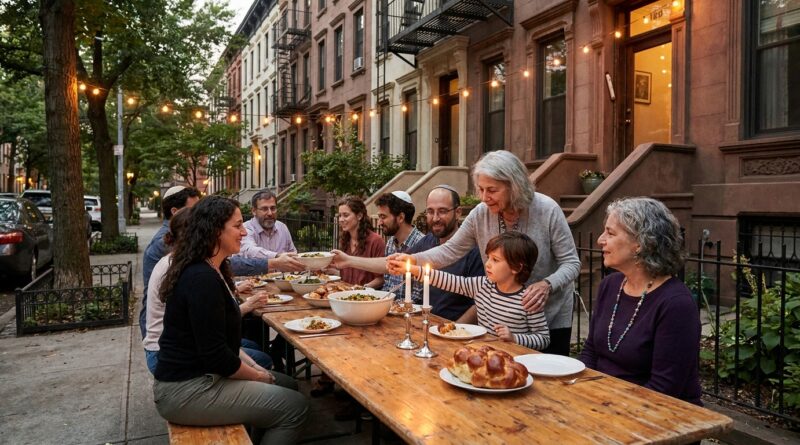
Tonight’s Shabbat Neighborhood Potlucks: The Hyper-Local Tables Quietly Turning ‘I Only See Jewish Life On Screens’ Into Real Food, Faces And Friends
You can get the strange feeling that Jewish life is thriving everywhere except where you live. You see crowded sanctuary photos, retreat group shots, and smiling Friday night tables on your phone, then look out your own window and think, “So where are my people?” That frustration is real. It can make you feel like a spectator to your own community. The good news is that you do not need a big synagogue budget, a formal guest list, or a perfect apartment to change that tonight. A simple Shabbat neighborhood potluck idea can turn “nobody’s here” into “we had six people around the table and stayed talking until dessert.” Start small. One text thread. One loaf of challah. Two candles. A few chairs borrowed from next door. Jewish community often looks big online, but in real life it usually starts in much smaller rooms, with ordinary people deciding not to spend another Friday night alone.
⚡ In a Hurry? Key Takeaways
- A Shabbat neighborhood potluck idea is one of the easiest ways to turn online Jewish belonging into real local community fast.
- Keep it simple. Invite 2 to 8 people, ask everyone to bring one dish, and use a short candle-lighting, kiddush, or just a moment of gratitude to begin.
- Low-pressure gatherings are often safer and more welcoming than waiting for a huge event, especially for people who feel rusty, interfaith, new in town, or unsure where they fit.
Why this works better than waiting for “real” community to appear
Lots of people think community is something you find. Often, it is something you host.
That is especially true now. There are Shabbat services, tot Shabbats, social justice minyanim, and Jewish cultural events happening across the country. But if none of them are on your block, or if they feel intimidating, expensive, far away, or already cliquish, they do not solve your Friday night.
A Shabbat neighborhood potluck idea does. It takes Jewish life out of the category of “content I consume” and puts it back where it belongs, at a table.
The beauty is how little you need. You do not need to sing beautifully. You do not need Hebrew. You do not need matching candlesticks from your grandmother. You just need enough intention to say, “Come over Friday. Bring something easy. We’ll light candles and eat together.”
What a neighborhood Shabbat potluck can look like tonight
Forget the fantasy version with perfect table settings and three homemade kugels. The real version is better because it can actually happen.
The easiest format
Try this:
- Pick a start time, like 7:00 p.m.
- Invite one to three households.
- Ask each person to bring one ready-to-serve item.
- You provide candles, grape juice or wine, and bread or challah if you can.
- Keep the ritual part to five minutes if your group is new to this.
That is enough. Really.
Who to invite
Start with who is nearby, not who is ideal.
That could mean:
- One Jewish neighbor you wave to in the hallway
- An interfaith couple in your building
- A coworker who once mentioned they miss Shabbat dinners
- A friend who is “Jewish-ish” and curious
- Parents from preschool who would love a family-friendly Friday
You are not forming a board. You are feeding people.
The invitation script that makes this feel easy
Most people overcomplicate the invite. Keep it casual and specific.
You can text:
“A few of us are doing a very simple Shabbat potluck at my place Friday at 7. Nothing fancy. Light candles, eat, hang out. Want to come? Bring any dish or drink if you’d like.”
That wording matters. “Very simple” lowers the pressure. “Nothing fancy” gives people permission to show up as they are. “Bring any dish or drink” avoids turning this into a logistics spreadsheet.
How to make it feel Jewish without making it feel intimidating
This is where many people freeze. They think if they cannot do the whole thing properly, they should not do anything at all.
That is backward.
Even a short, imperfect ritual can anchor the night.
A beginner-friendly flow
Here is a gentle structure:
- Welcome everyone in.
- Light candles.
- Say a blessing, or read one English reflection on rest and gratitude.
- Make kiddush over wine or grape juice, if that feels right.
- Bless or simply break challah.
- Eat slowly.
- Go around and ask one easy question, like “What helped you get through this week?”
That last part matters. The conversation is not filler. It is the point.
If you want more ideas for bringing Shabbat into your home in a low-pressure way, Tonight’s Shabbat Dinners For Jewish American Heritage Month: The Simple Ritual Turning May Into A Month-Long Homecoming captures that same spirit of making Jewish connection feel close, not ceremonial and far away.
What to serve when you are tired, busy, or broke
Potluck is your friend because it spreads the load. You do not need to cook a whole meal.
The low-effort menu
- Store-bought challah or any good bread
- Hummus and cut vegetables
- Rotisserie chicken or a vegetarian main
- Rice, salad, or pasta
- Cookies, fruit, or bakery rugelach
If everybody brings one thing, the table fills itself.
If guests keep asking what they should bring
Give categories, not assignments.
Say, “Bring a side, dessert, or drink.”
That prevents twelve dips and no dinner, while still keeping the mood relaxed.
How this helps with loneliness better than another scroll session
There is a specific kind of loneliness that comes from seeing other people belong. It is not just that you are alone. It is that other people seem connected in a way that feels organized, photogenic, and out of reach.
A neighborhood potluck cuts through that fast. Not because it solves everything, but because it replaces abstraction with actual human presence.
You smell the food. You hear someone laugh in your kitchen. Somebody asks where you got the candlesticks. A person who was a hallway acquaintance becomes someone who now knows how you take your tea.
That is how local community starts. Not with branding. With repetition.
If you are nervous about safety or boundaries
You do not have to open your door to the whole internet. Hyper-local does not mean reckless.
Smart ways to keep it comfortable
- Invite people you already know, even lightly
- Ask a friend to co-host
- Keep the first gathering small
- Set a clear start and end time
- Use your building common room if home feels too personal
If you are worried about being the only one responsible, make this a rotating dinner from the start. Say, “If this is fun, maybe we can trade off apartments next month.”
What to do if nobody comes the first time
This part is important. A weak first response does not mean there is no Jewish life near you. It may just mean people are tired, already committed, shy, or unsure what you mean.
Try again with less lead time or more clarity.
“Two of us are doing Shabbat dinner this Friday. Super casual. If you’re free, come by.”
That is often easier to say yes to than a broad, ambitious invite sent two weeks ahead.
Also, if just one person comes, that still counts. Especially if that one person leaves saying, “We should do this again.”
How to turn one dinner into an actual local rhythm
The secret is not scale. It is consistency.
Keep the second gathering even easier
Do not respond to a good first night by making it twice as elaborate. Make it easier to repeat.
- Use paper goods if needed
- Repeat the same simple menu structure
- Share hosting
- Start a small group chat
- Pick the next date before people leave
That is how “we should totally do this sometime” becomes “same place next month?”
Why this matters after the big public events fade
There is often a letdown after a busy season of heritage programming, festivals, speakers, and public celebrations. The calendar goes quiet. Your inbox slows down. Pride is still there, but the structure around it fades.
This is exactly when a Shabbat neighborhood potluck idea makes sense. It carries that visible, public Jewish energy back into private life. It says the month may be ending, but the table does not have to disappear with it.
At a Glance: Comparison
| Feature/Aspect | Details | Verdict |
|---|---|---|
| Ease of starting | Needs only a few people, simple food, and a basic invitation text | Very beginner-friendly |
| Community impact | Turns passive online belonging into face-to-face relationships on your own block | High value for low effort |
| Pressure level | Flexible for secular, traditional, interfaith, family, or first-time guests | Best when kept simple and welcoming |
Conclusion
If Jewish life has felt like something happening somewhere else, a Shabbat neighborhood potluck idea is a practical way to bring it home tonight. Not someday. Not after you find the perfect community. Tonight. Right now there are services, tot Shabbats, and creative minyanim happening across the US, but many Jews still feel like they are watching other people belong from a distance. A small, repeatable Friday night meal changes that by giving you something real to do with the people actually near you, whether that is one Jewish neighbor, an interfaith couple down the hall, or a few friends who have never made kiddush before. As the bigger Jewish American Heritage Month events wrap up and the calendar gets quieter, this kind of table keeps the warmth going. It replaces doomscrolling with candles, bread, conversation, and the quiet relief of realizing community might be closer than you thought.