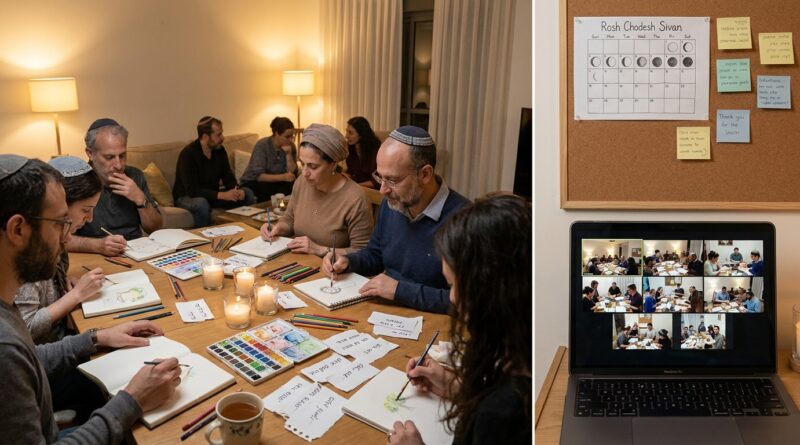
Tonight’s Rosh Chodesh Sivan Creativity Circles: The Online Art Sessions Quietly Turning ‘I Don’t Feel Spiritual Right Now’ Into A Hands‑On Fresh Start
If you have looked at the calendar, seen Rosh Chodesh Sivan, and felt absolutely nothing, you are not the only one. A lot of people want the fresh start energy of a new Jewish month, especially one that leads right into Shavuot, but feel worn out by lectures, drained by long davening, or just too fried to sit through another hour of words. After a heavy news scroll or a lonely Sunday, “be more spiritual” can sound like one more task. That is why tonight’s quiet little trend matters. Communities are holding low-pressure online art circles for Rosh Chodesh Sivan, and they are filling up because people want to do something with their hands, not just think harder. A simple prompt, some paper, a few markers, and a room full of people also beginning again can feel more real than a polished program. For many, this is the gentlest way back into Jewish time.
⚡ In a Hurry? Key Takeaways
- Yes, a Rosh Chodesh Sivan creative event can be a real spiritual entry point, especially if prayer or study feels hard right now.
- You can join or host one tonight with basic supplies, one simple prompt, and 45 to 60 minutes on Zoom.
- Keep it low-pressure. No art skill, deep text knowledge, or polished teaching style is needed for it to work.
Why these circles are landing right now
Rosh Chodesh Sivan has its own mood. It is not just “new month, new me.” It opens the stretch toward Shavuot, a time tied to preparation, presence, and showing up. The problem is that many people do not feel especially ready, present, or inspired.
That gap is exactly where creative circles make sense. Instead of asking people to jump straight into big ideas, they offer a smaller doorway. Draw a mountain. Make a color map of your week. Tear paper into a collage about what you want to receive this month. Write one line in the chat. Hold up your page if you want. That is enough.
Places like Berkeley’s Jewish Studio Project helped make this style familiar, but now the idea is spreading more loosely through synagogue groups, artists, educators, and indie rabbis running Zoom gatherings from home. The appeal is simple. Less talking. Less pressure to sound smart. More room to breathe.
What a Rosh Chodesh Sivan creative event actually looks like
If you are picturing a serious art class, relax. Most of these sessions are much more like guided reflection with markers.
The usual format
A typical online session runs 45 to 75 minutes. You log in. The host welcomes everyone and names the theme. For Rosh Chodesh Sivan, that might be readiness, receiving, wilderness, voice, or beginning again. Then comes a short grounding moment. Maybe a niggun, a verse, a blessing for the new month, or one question like, “What am I arriving with tonight?”
After that, people make something. The prompt is usually open enough that nobody can do it “wrong.” Then there is optional sharing. Not a critique. Just a chance to say, “Here’s what showed up for me.”
Supplies are usually very basic
You do not need a studio. Most hosts tell people to gather whatever is around:
- Printer paper, notebook paper, or cardstock
- Markers, crayons, pens, or colored pencils
- Old magazines, scissors, and glue if collage is part of it
- A candle or cup of tea if you want a ritual feel
That simplicity is part of the point. The barrier to entry stays low.
Why it can work better than another lecture
When people say they feel spiritually flat, they often do not mean they reject spirituality. They mean they are overloaded. Too much input. Too many words. Too much trying to process everything through the brain alone.
Creative practice helps because it slows the pace and puts attention back into the body. Your hands move. Your eyes focus. You notice color, shape, breath, silence. For people who feel text-shy or emotionally scrambled, that can be a more honest place to start than asking them to produce a polished insight on command.
It also makes Jewish time feel less abstract. Rosh Chodesh is not only something on a calendar app. It becomes a thing you marked. You sat down. You made space. You made a page. That matters.
How to find a Rosh Chodesh Sivan creative event tonight
If you want to join rather than host, search with plain language. Try terms like “Rosh Chodesh Sivan creative event,” “Jewish art Zoom Rosh Chodesh,” “Rosh Chodesh women’s circle art,” or “Shavuot preparation art workshop.” Check synagogue newsletters, Jewish community center calendars, Instagram stories from local rabbis and educators, and community WhatsApp groups.
Do not assume it has to be local. One of the nice things about this trend is that online format makes geography less important. A tiny community can join a session led from another city, and a solo participant can show up without needing to know anyone.
What to look for before you sign up
- Clear length, ideally under 90 minutes
- Simple supply list
- Language that says “no art experience needed”
- Optional sharing, not forced sharing
- A tone that feels warm, not performative
If the event listing sounds like a graduate seminar with acrylic paint, skip it unless that is your thing. Tonight is about re-entry, not proving something.
How to host one yourself with almost no budget
If your community does not have anything planned, you can still make this happen tonight. Truly. This is one of the easiest plug-and-play Jewish gatherings to run.
A simple 60-minute outline
Minute 1 to 10: Welcome people. Light a candle if you like. Say a short blessing for the new month or just name that tonight is Rosh Chodesh Sivan, the month leading to Shavuot.
Minute 10 to 15: Offer one short text, song lyric, or question. Keep it brief. One line is enough.
Minute 15 to 35: Give the art prompt. Examples:
- “Draw the mountain you are standing at this month.”
- “Make a collage of what you want to receive and what you need to set down.”
- “Use colors and shapes to show how you want Sivan to feel.”
- “Create an image of the voice you are ready to hear.”
Minute 35 to 55: Optional sharing. Invite people to hold up their page or describe one part of it. Keep the responses gentle. “Thank you” is enough.
Minute 55 to 60: Close with a hope for the month, a niggun, or one word in the chat.
What the host needs to do well
Not much, honestly. Your main job is to lower the stakes. Say out loud that stick figures are welcome. Silence is welcome. Cameras off are welcome. Leaving early is welcome. The more permission people feel, the more likely they are to actually arrive.
Good prompts for people who feel awkward about art
This matters because many adults hear “creative session” and instantly think, “I am bad at art.” The fix is to use prompts that focus on reflection, not talent.
- Color check-in: Pick three colors for what this past month felt like, then add one color for what you want next.
- Shape prayer: Fill the page with shapes that match your energy right now. No drawing skill needed.
- Found-word blessing: Cut words from old magazines and build a blessing for Sivan.
- Mountain and path: Draw a mountain for Sinai and a path showing where you are on the way there.
- Hands prompt: Trace your hand and write inside it what you are carrying into the new month.
These work because they are concrete. You do not have to be “in the mood.” You just start.
Who these gatherings are especially good for
Not every format fits every person. But this one is unusually good for a few groups that often get missed.
People tired of being talked at
If your soul is not asking for another explanation tonight, that is fair. A creative circle gives you a way to participate without needing to absorb a lot of information.
People who feel Jewish, but disconnected
Some people are not rejecting ritual. They just cannot find a live wire to it right now. Making something can restore that wire in a quieter way.
Small communities with limited staff
You do not need a scholar-in-residence or a whole prayer team. You need a host, a Zoom link, a prompt, and the confidence to keep it simple.
At a Glance: Comparison
| Feature/Aspect | Details | Verdict |
|---|---|---|
| Time and energy | Usually 45 to 75 minutes, with simple supplies and no prep-heavy homework | Very approachable for tired people |
| Spiritual accessibility | Works for people who feel disconnected from text study or long services | Strong fit for gentle re-entry |
| Cost and setup | Can be run on Zoom with paper, pens, and one thoughtful prompt | Excellent low-budget option |
Conclusion
Today is Rosh Chodesh Sivan, the first day of the month that leads straight into Shavuot. If you are not feeling uplifted, that does not mean you missed your chance. Communities from Berkeley’s Jewish Studio Project to indie rabbis on Zoom are finding that art-based gatherings are packed for a reason. People want a break from constant talking, and they want a way to feel Jewish time in their bodies again. A Rosh Chodesh Sivan creative event can offer exactly that. It is gentle, low-pressure, and surprisingly doable. You can join one tonight, or host one with almost no budget and no fancy teacher. A blank page, one prompt, and a little room to breathe may be more than enough to help this month begin.