Rosh Chodesh Iyar 5786: The Quiet Weeknight Gathering That’s Becoming Judaism’s Monthly Reset Button
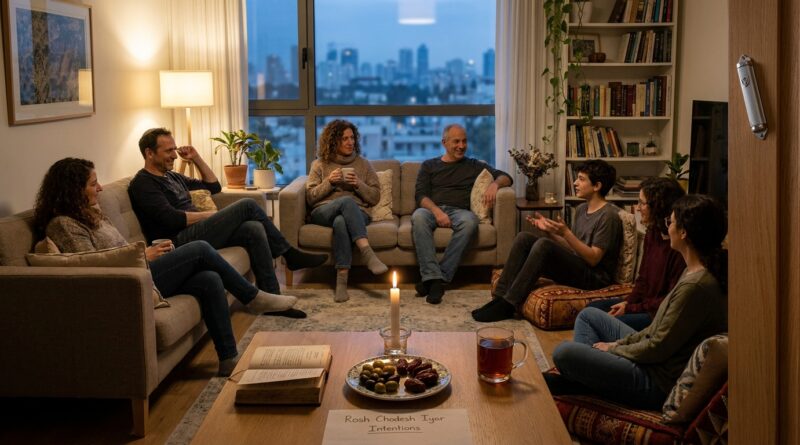
If you feel a little spiritually wrung out right now, you are not imagining it. Passover asks a lot. Yom HaShoah asks something different, and often even deeper. By the time the calendar turns again, many Jews are left wanting connection without having the energy for another big event, long service, or carefully produced program. That is exactly why Rosh Chodesh Iyar is quietly landing for so many people this year. It begins Thursday night, and it offers something rare. A real Jewish moment that does not demand a huge emotional performance. If you are wondering how to celebrate Rosh Chodesh Iyar in community, think small, warm, and repeatable. A living room. A circle of chairs. Tea, candles, a psalm, a check-in, one small intention for the month ahead. Not a production. More like a reset button. The kind you can actually press when life feels noisy, heavy, or slightly off-center.
⚡ In a Hurry? Key Takeaways
- Rosh Chodesh Iyar works best in community when it stays simple, honest, and low-pressure.
- Start with a 30 to 60 minute gathering: light refreshments, a short text or prayer, one personal check-in, and one intention for the month.
- You do not need a rabbi, a big budget, or a formal service to make it meaningful. Consistency matters more than scale.
Why this month feels different
Iyar does not arrive with the drama of Nissan or the weight of the High Holidays. That is part of its gift.
It comes after Passover, after the seders, after the cleaning, after the family logistics, after the emotional intensity of remembering slavery and freedom. This year, it also arrives in the shadow of Yom HaShoah and on the path toward Yom HaZikaron and Yom HaAtzmaut. That is a lot of feeling in a short stretch of calendar.
Many people do not need another major event right now. They need somewhere to land.
That is where Rosh Chodesh can help. The new month is one of Judaism’s quieter tools. It marks time, but gently. It gives you permission to pause and ask, “Where am I, really?” Then it invites other people into that question too.
How to celebrate Rosh Chodesh Iyar in community without making it a whole production
The best version is usually the easiest one to repeat.
Keep the group small
Think 5 to 15 people. That is often the sweet spot. Big enough for shared energy. Small enough that people can actually speak.
You can host it in a home, synagogue classroom, JCC lounge, dorm common room, or even a backyard if the weather cooperates. If people are spread out, a video call can still work, especially if everyone knows this is meant to be brief and grounded.
Set a clear tone before people arrive
Your invitation matters. A lot.
Say what this is and what it is not. For example: “Join us Thursday night for a simple Rosh Chodesh Iyar gathering. No speeches, no pressure, just a chance to mark the new month together after an intense season.”
That kind of wording tells tired people they are safe to come as they are.
Give it a shape
People relax when they know the plan. A loose structure is enough:
- Welcome and light refreshments
- A blessing, niggun, psalm, or short reading
- One check-in question
- One intention for Iyar
- A closing blessing or moment of quiet
That is it. You do not need a printed booklet unless your group likes that sort of thing.
A simple 45-minute format you can use this Thursday night
1. Start with food and a breath
Put out tea, fruit, cookies, nuts, whatever is easy. This is not about impressing anyone. It is about signaling, “You can exhale here.”
Then open with one minute of silence, or a simple line such as, “We are welcoming the month of Iyar together, carrying whatever this season has brought us.”
2. Use one short Jewish text
Keep it short enough that nobody feels they just walked into a class by accident.
You might use a verse from Hallel, a line about renewal from Psalms, or a brief teaching about the moon and the Jewish calendar. The point is not mastery. The point is orientation.
Iyar is often linked with healing in Jewish thought, which can be especially meaningful right now. Even naming that theme can give people something solid to hold.
3. Ask one real check-in question
Do not ask for life stories. Ask something manageable.
Good options include:
- What has this past month taken out of you?
- What do you want more of in Iyar?
- What is one thing you are carrying tonight?
- Where do you need healing, rest, or steadiness?
Let people pass if they want. That is important. A low-pressure gathering stays low-pressure when silence is allowed.
4. Set one small intention
This is the part that turns the evening into a reset instead of just a hangout.
Ask each person to name one small intention for the month. Not a giant self-improvement project. Something they can actually do.
Examples:
- Call one friend I have been avoiding because I am tired
- Say Modeh Ani slowly three mornings a week
- Walk without my phone once each Shabbat
- Check in on an older neighbor before Yom HaAtzmaut
- Make space to remember, not just rush to the next event
5. Close gently
End with a shared blessing for the month, the priestly blessing, a niggun, or simply this: “May this new month bring healing, clarity, and enough strength for what is ahead.”
People do not need a big finale. They need a clean ending.
Why this works especially well right now
Rosh Chodesh Iyar lands in a narrow emotional corridor. Behind us is Yom HaShoah. Ahead are Yom HaZikaron and Yom HaAtzmaut. Some people feel grief. Some feel pride. Some feel tension, confusion, numbness, or all of the above before dinner.
A modest new-month gathering makes room for that complexity without forcing everyone into one mood.
That matters.
It also helps people re-enter Jewish communal life through a side door instead of the main stage. Someone who cannot handle a large event may still be able to manage a cup of tea and a circle of eight people. Often, that is enough to bring them back into connection.
What not to do
Do not overprogram it
The minute the gathering starts to feel like a conference breakout session, you lose the magic. Keep the moving parts few.
Do not turn it into a debate night
This is not the evening to solve every communal argument or process every headline. You can acknowledge the hard realities in Israel and Jewish life without making the room carry more than it can hold.
Do not confuse informal with careless
Simple does not mean sloppy. Set chairs out. Start on time. Prepare the reading. Think through the flow. People can feel when care has been taken.
Who should host it?
Almost anyone with warmth and a little steadiness.
A rabbi can host. So can a lay leader, educator, friend group organizer, Hillel student, or the person in the community who is good at texting, “Come over, I made tea.”
If you are waiting for official permission, this is it. Rosh Chodesh has always had room for grassroots Jewish life. In some ways, that is the whole point.
How to make it repeatable for all twelve months
This is where the real value kicks in.
If Thursday night goes well, do not treat it as a one-off. Put the next date on the calendar before people leave. Jewish time gives you twelve built-in chances a year to try again. That is a generous system.
To make it sustainable:
- Use the same basic format each month
- Rotate homes or hosts
- Keep the guest list manageable
- Share responsibility for snacks and setup
- Choose one theme per month, not five
People are much more likely to come back to something they understand. Predictability is underrated, especially after a heavy communal season.
If your community includes people who are grieving or checked out
Then this may be exactly the right kind of gathering.
Do not ask those people to arrive cheerful. Do not ask them to explain themselves. Just make room.
You can say, “Some of us come into Iyar tired, some hopeful, some sad, some unsure. All of that belongs here.” One sentence like that can lower the emotional cost of walking through the door.
If someone cries, that is fine. If someone says very little, that is fine too. The goal is not to produce a feeling. The goal is to create a container strong enough to hold different feelings together.
At a Glance: Comparison
| Feature/Aspect | Details | Verdict |
|---|---|---|
| Best gathering style | Small group, simple structure, homey setting, 30 to 60 minutes | Most meaningful and easiest to repeat |
| What to include | Short text or prayer, one check-in, one intention, gentle closing | Enough Jewish substance without exhausting people |
| Common mistake | Overplanning, overtalking, or making it feel like formal programming | Avoid. It raises the barrier to entry |
Conclusion
Rosh Chodesh Iyar begins Thursday night, and that timing is a quiet gift. Jewish communities around the world are using these new-month evenings as a low-pressure way to gather people who are exhausted, grieving, or simply drifting after a hard stretch. You do not need to build a major event to make that useful. A modest, repeatable ritual can be enough. A few people, a little food, a short prayer or reading, honest check-ins, and one small intention for the month ahead. That gives people a place to name where they are after Yom HaShoah, steady themselves before Yom HaZikaron and Yom HaAtzmaut, and remember something easy to forget. Jewish time is not only made of big-ticket holidays. It also gives us twelve regular chances a year to begin again, together, in a way that ordinary people can actually sustain.