Today’s Celebrate Israel Festivals: The Pop-Up Street Fairs Quietly Rewiring Jewish Belonging in American Cities
If you have been staring at Israel headlines and feeling pulled in five directions at once, you are not alone. A lot of Jewish families feel tired, wary, and hungry for something more human than another argument on a screen. They want a place to bring the kids, meet neighbors, eat something good, hear music, and feel Jewish in public without signing up for a whole institution first. That is exactly why the sudden rise of citywide Celebrate Israel festivals matters right now. Across the country, these street-fair style gatherings are giving people a lower-pressure way to show up. Think food stalls, kids’ crafts, dancing, local Jewish groups, and plenty of room for mixed, interfaith, and curious families. If you have found yourself typing “Celebrate Israel festival near me” and getting spotty results, now is the time to check your local Jewish federation, JCC, synagogue roundups, and city Jewish event calendars before the weekend slips by.
⚡ In a Hurry? Key Takeaways
- Celebrate Israel festivals are happening now in major US cities, and they offer an easy, family-friendly way to connect locally.
- If you are searching for a Celebrate Israel festival near me, check your local federation, JCC, Jewish community newsletter, and social pages today, because many are announced close to the date.
- These events are valuable because they welcome Jews, allies, mixed families, and the Israel-curious without requiring membership or deep prior knowledge.
Why these festivals matter more than they might seem
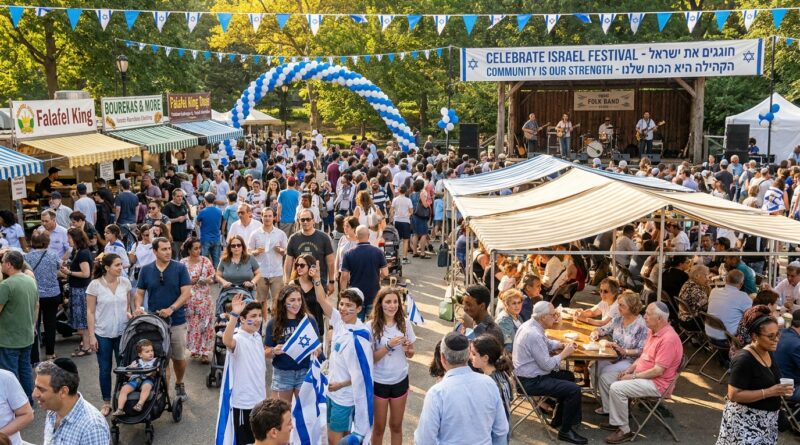
From the outside, a Celebrate Israel festival can look simple. Music. Falafel. Booths. Face painting. Maybe a dance performance and some blue-and-white balloons.
But that misses the point.
For many American Jews, especially in the past year and a half, public Jewish life has felt heavier. Some people feel fiercely connected to Israel. Some feel conflicted. Some feel both at the same time. Many are just exhausted. A local festival does not solve all of that. It does something quieter and, in some ways, more useful. It gives people a place to be together in real life.
That matters. A lot.
What a Celebrate Israel festival usually looks like
These events vary by city, but the formula is familiar because it works. Most include live music, Israeli and Jewish food vendors, family activity areas, community organization tents, cultural performances, and spaces to learn about travel, volunteering, schools, camps, and local service groups.
For families with kids
This is often the easiest entry point. Children do not need a long explanation before they enjoy a craft table, a bounce area, a drumming circle, or a snack. Parents get something just as important. A chance to exhale and be around other people navigating similar questions about identity, safety, and belonging.
For mixed and interfaith households
Street fairs are easier than formal services. There is no need to know the melodies, the prayers, or when to stand up. You can walk through, stay 20 minutes, or spend the whole afternoon. That flexibility can make all the difference for couples and families who want connection without feeling tested.
For people who feel politically conflicted
Not everyone arriving at these festivals comes with the same story or the same opinion. That is real. But a public community event can still offer something solid. You do not need to have every thought settled before you show up. Sometimes showing up is how people start sorting out what they feel.
Why so many people miss them until it is too late
Here is the frustrating part. Plenty of these events are big, joyful, and packed, yet the average person still hears about them after the photos hit Instagram.
There are a few reasons. Promotion is often scattered across federation emails, synagogue bulletins, JCC calendars, WhatsApp groups, school newsletters, and social media posts that disappear fast. If you are not already plugged into one or two of those channels, it is easy to miss the whole thing.
That is why searching “Celebrate Israel festival near me” can feel weirdly hit or miss. The events are there. The information is just spread all over the place.
How to actually find a Celebrate Israel festival near you
If you want the practical version, start here.
1. Check your local Jewish federation website
In many cities, the federation is the central organizer or co-sponsor. Look at the events page, not just the homepage.
2. Search your JCC calendar
JCCs often share festival listings even when they are not the main host.
3. Look at major synagogue and Jewish day school newsletters
You do not need to be a member to use their public calendars. Bigger congregations often post citywide events.
4. Search social media by city name
Try combinations like “Celebrate Israel Boston,” “Celebrate Israel Miami,” or “Israel independence festival Seattle.” Facebook Events and Instagram are still useful for this.
5. Check local Jewish newspapers and community sites
Community outlets often publish roundups that are easier to scan than individual event pages.
6. Search right before the weekend
It is not ideal, but many final details get posted close to the event date. If you looked once and found nothing, look again.
The bigger shift hiding in plain sight
These are not just holiday parties. They are part of a broader change in how people connect to Jewish life in America.
For decades, a lot of communal belonging ran through institutions first. Join a synagogue. Enroll in a school. Become a member. Show up regularly. That still matters, of course. But many people now enter Jewish life sideways. Through a food festival. A park gathering. A community concert. A volunteer day. A big public celebration where nobody asks what your denominational label is before handing you a flyer and a cookie.
That is not a small shift. It means belonging can start with presence, not paperwork.
Why public joy counts right now
There is also something brave about these festivals. At a time when many Jews are uneasy about being visibly Jewish in public, these events choose joy anyway. Not naive joy. Not forced cheerfulness. Just the simple insistence that Jewish public life should not be reduced to fear, mourning, or argument.
Music in the street matters. So does a kids’ dance show. So does seeing your neighbor stop by. So does standing in line for hummus next to someone who has been just as overwhelmed as you have.
These moments do not erase anxiety. They interrupt isolation.
What community leaders can learn from them
If you help run a synagogue, school, JCC, campus group, or neighborhood network, there is a useful lesson here. The people showing up are not only the usual insiders. They include young families, unaffiliated adults, grandparents, non-Jewish spouses, allies, and people returning after a long absence.
What brings them in is not complexity. It is openness.
The model is worth noticing. Keep it public. Make it family-friendly. Lower the barriers. Offer culture, not just messaging. Give people multiple ways to participate. Let them browse. Let them stay light. Let them go deeper if they want.
If you are unsure whether to go
You do not need to arrive with a flag and a speech. You can go because your kids need to get out of the house. You can go because you want to hear Hebrew songs and eat rugelach. You can go because you miss being around Jews and do not know how to say that out loud. You can go because your family is mixed and this feels easier than a formal service. You can go because you are struggling and want to feel less alone.
That is enough.
At a Glance: Comparison
| Feature/Aspect | Details | Verdict |
|---|---|---|
| Ease of entry | Open-air, drop-in events with food, music, and booths. No membership usually needed. | Excellent for first-timers and unaffiliated families. |
| Family friendliness | Kids’ zones, crafts, performances, and room to wander at your own pace. | One of the lowest-pressure Jewish community events to attend with children. |
| Emotional value | Offers in-person connection during a tense time, even for people who feel conflicted or disconnected. | High value, especially for people tired of doomscrolling and isolation. |
Conclusion
If you have been feeling stuck between caring deeply and feeling worn down, these festivals offer a rare middle path. Tens of thousands of Jews and allies are gathering this week in cities like New York, Los Angeles, Miami, Boston, Houston, and Seattle to mark Israel’s 78th Independence Day with music, food, kids’ zones, and community tents. That is not just a nice weekend plan. It is a reminder that Jewish belonging can still be local, warm, visible, and welcoming. For anxious or isolated people, it is a chance to trade one more hour of scrolling for something embodied and real. For mixed and interfaith families, it is a low-barrier way in. And for community leaders, it is a working example of joyful public Judaism at a moment when many people need exactly that. So if you are wondering whether there is a Celebrate Israel festival near me, check today. The hardest part may simply be hearing about it in time.