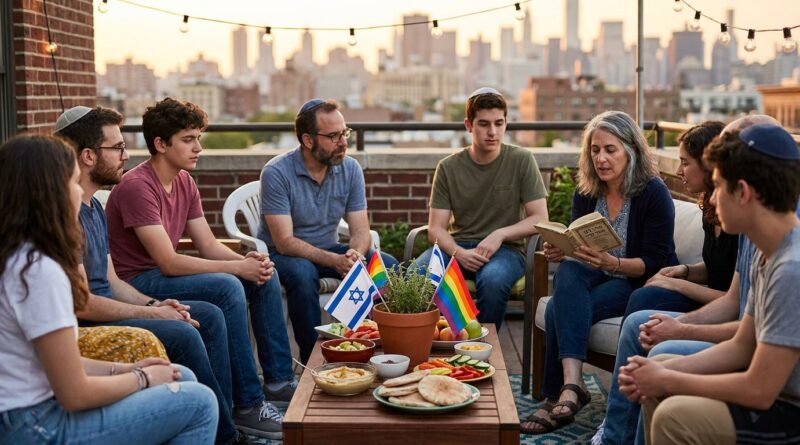
Today’s Jerusalem Day Pop‑Ups: The Local Events Quietly Turning ‘Israel Feels So Far Away’ Into Something You Can Actually Walk Into
You can be flooded with Israel opinions all day and still have nowhere real to go with your own feelings. That gap is especially sharp on Jerusalem Day. For many people, Yom Yerushalayim passes unnoticed unless you follow the Israeli calendar closely, yet the emotions around Jerusalem are anything but small. Since October 7, a lot of Jews have felt stuck between two bad options. Either the conversation is a fight online, or it disappears completely in everyday life. What is quietly changing that today is something much more human-sized. Across North America and beyond, synagogues, Hillels, Moishe Houses, student groups, and informal friend circles are hosting low-pressure Jerusalem Day gatherings. Not giant rallies. Not debate stages. Think rooftop halal-kosher BBQs, a few songs, a short learning session, a photo walk, a candle, a personal story, and one practical way to help. If you have been searching for Jerusalem Day events near me, this is the day to stop scrolling and actually walk into one.
⚡ In a Hurry? Key Takeaways
- Jerusalem Day events near you are often small, local, and easier to join than the internet makes it seem.
- Check synagogues, Hillels, JCCs, Moishe Houses, and local Jewish Instagram or WhatsApp groups today, not next week.
- The best events are low-pressure and thoughtful, with room for mixed feelings, listening, and one simple action step.
Why this matters today
Jerusalem Day can slip by fast if you are not already tuned in. It is not one of those dates that automatically shows up in every community calendar. But for people trying to make sense of Jewish identity, Israel, memory, prayer, grief, hope, and family history, it can hit hard.
That is why these local pop-ups matter. They give shape to feelings that otherwise stay vague. They create a middle space between silence and shouting. You do not need to arrive with a polished opinion. You just need to arrive.
What these Jerusalem Day gatherings actually look like
If you hear “event” and picture something formal, don’t. A lot of the best Yom Yerushalayim gatherings are modest by design.
Small learning circles
These may meet in a synagogue library, a campus lounge, or someone’s living room. Usually there is one short text, maybe about Jerusalem in prayer, maybe about 1967, maybe about longing and return. The goal is not to win an argument. It is to think together.
Story nights across generations
This is one of the strongest formats right now. A grandparent talks about what “Next year in Jerusalem” meant growing up. A college student shares what Jerusalem means after this past year. Suddenly the topic becomes personal, not abstract.
Music, food, and low-key ritual
Some groups are hosting rooftop dinners, halal-kosher BBQs, or simple potlucks with niggunim and songs for peace. Others are lighting a candle, sharing one poem, and ending with tea and conversation. Simple works.
Gallery walks and visual events
Photos from the Old City, art inspired by Jerusalem stone, maps, family travel pictures, or even printed snapshots on a wall can do something powerful. They let people connect through image and memory before words get heavy.
One practical action
The most grounded events usually include one next step. Writing letters to lone soldiers. Donating to a Jerusalem-based mental health group. Making care packages. Sending support to affected families. That matters because it keeps the evening from becoming only symbolic.
How to find Jerusalem Day events near me
If you are actively searching “Jerusalem Day events near me,” speed matters. Many of these gatherings are organized quickly and shared locally, not through big national ads.
Start with the obvious places
Check the websites and social accounts for:
- Local synagogues across denominations
- Hillel chapters
- JCCs
- Moishe House hosts
- Young adult Jewish groups
- Jewish day schools and campus Jewish studies programs
Use the channels people actually use
A lot of the best events never make it to Google in a clean way. Look on Instagram Stories, community newsletters, campus email lists, Facebook groups, and WhatsApp chats. Search for “Yom Yerushalayim,” “Jerusalem Day,” “Jerusalem learning,” and “community gathering.”
Ask one direct question
If you cannot find anything public, message a rabbi, Hillel staffer, or community organizer and ask, “Do you know of any Jerusalem Day events near me tonight or this week that are more reflective than political?” That wording helps. It tells people what kind of space you want.
What makes a good event right now
Not every event will fit every person. But the most useful ones today tend to share a few traits.
They are welcoming to people with mixed emotions
You should not have to perform certainty at the door. A healthy gathering makes room for love, pain, confusion, attachment, criticism, prayer, and memory to sit in the same room.
They stay human-scale
Ten to forty people can sometimes do more than a huge crowd. You can hear a voice crack. You can ask a question. You can actually meet someone.
They include Jewish grounding
A verse, a song, a blessing, a teaching, a family memory. Something rooted. That rootedness helps people feel they are part of a living story, not just reacting to headlines.
They end with a next step
The best events answer the question: now what? Even one small action can keep the feeling from evaporating by tomorrow morning.
If there is no event near you, make one tonight
This is the underrated part. You do not need a budget, a panel, or perfect language. You need a room, a few people, and a simple structure.
A very doable 45-minute format
- Light one candle.
- Read one short text, song lyric, or poem about Jerusalem.
- Invite one person to share a five-minute story about what Jerusalem means to them.
- Go around and let each person say one sentence, memory, question, or hope.
- Close with one action, like writing notes, giving to a cause, or planning a follow-up gathering.
This can happen in a dorm lounge, backyard, book club, synagogue classroom, office conference room, or around a kitchen table.
Why these quieter events may matter more than the loud ones
Big public moments have their place. But local Jerusalem Day circles do something different. They let people process instead of posture. They lower the temperature without lowering the stakes.
That is especially important for readers who feel emotionally tangled about Israel right now. A thoughtful event does not force a single script. It gives you a place to be in relationship, with Jerusalem, with your community, and with your own questions.
At a Glance: Comparison
| Feature/Aspect | Details | Verdict |
|---|---|---|
| Event style | Usually small gatherings, learning circles, meals, music, or story-sharing instead of formal programs | Best for people who want a real conversation, not a performance |
| How to find one | Search local synagogues, Hillels, JCCs, Moishe House hosts, newsletters, Instagram, and WhatsApp groups | Fastest route if you are looking today |
| Emotional fit | Good events allow complexity, Jewish grounding, and one practical action step | The most helpful option for people tired of online arguments |
Conclusion
Jerusalem Day is today, and it can easily vanish into the news cycle if you are not plugged into an Israeli calendar. But that does not mean it has to pass you by. Across North America and beyond, quiet local gatherings are making space for a more grounded kind of connection. A rooftop halal-kosher BBQ with songs for peace. A small learning circle on the reunification of Jerusalem. A gallery walk of Old City photos. A story night where grandparents and grandkids compare what “Next year in Jerusalem” means across generations. For many Jews, especially after October 7, Israel talk feels either overheated or absent. These modest events offer a third option. Show up. Light a candle. Hear one story. Learn one song or text. Take one small action. If you find one, go. If you cannot find one, start one. The point is not to have everything figured out. It is to remember that your relationship with Jerusalem is allowed to be explored in community, at your own pace, face to face.