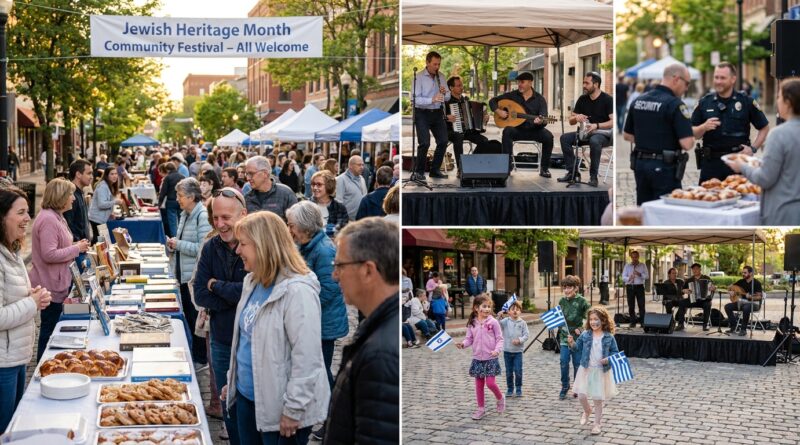
Tonight’s Jewish Heritage Month Pop‑Up Festivals: The Street‑Level Events Quietly Turning ‘I Only See Jewish Life Online’ Into Real Music, Food And Faces
You have probably had this moment already. You see post after post about Jewish American Heritage Month or Jewish Culture Month, maybe a concert clip, maybe a challah workshop, maybe a smiling crowd in another city, and you think, “Okay, but where do I actually go?” That frustration is real. A lot of people want Jewish life in person right now, not just on a screen, but they do not want to walk into something blindly, feel out of place, or stumble into an event that feels more tense than welcoming. The good news is that tonight and this week, across North America and the UK, there really are small, street-level events happening. Pop-up festivals, public library culture nights, outdoor music sets, neighborhood food fairs, family craft afternoons. They are often easier to join than they look. You just need a better way to spot them, and a little confidence about what happens once you arrive.
⚡ In a Hurry? Key Takeaways
- Yes, there are likely Jewish Heritage Month events near you this week, but many are listed through local JCCs, libraries, museums, synagogues, arts groups, and city event calendars instead of one big master list.
- Start with a fast 15-minute search: your city name plus “Jewish Heritage Month,” “Jewish Culture Month,” “JAHM,” “festival,” “library,” or “outdoor concert.” Then check Instagram and Facebook Events.
- Most pop-up events are low-pressure, family-friendly, and fine for first-timers or curious friends. Look for public venues, posted security, and clear host details if safety matters to you.
Why these events matter more than another post in your feed
After a heavy year online, a lot of people are tired of Jewish life feeling like something that only exists in argument threads, headlines, or comment sections. Real-life events do something different. You hear live music. You smell the food before you see it. You notice grandparents, students, kids with face paint, someone dancing badly but happily. It puts Jewish culture back at human size.
That is why these smaller events matter. They are not always flashy. Some are a klezmer set in a park. Some are a book display and folk music night at a library. Some are community fairs with Israeli dance, Sephardi food, Yiddish songs, or local makers selling art and Judaica. But they remind people that Jewish life is not just content. It is people.
How to find Jewish Heritage Month events near me, fast
If you are searching for Jewish Heritage Month events near me, skip the idea that there is one perfect website with everything on it. Usually there is not. The better move is to check a handful of local sources that together give you the real picture.
Start with the obvious, but do it smarter
Search your city or region plus these phrases:
- Jewish Heritage Month events near me
- Jewish American Heritage Month + your city
- Jewish Culture Month + your city
- Jewish festival + your city + tonight
- JCC events + your city
- Jewish museum events + your city
- library Jewish heritage event + your city
This sounds simple, but the wording matters. A lot of smaller events are filed under “culture,” “community,” “music,” or “family day,” not “festival.”
Check these sources in this order
Start with local Jewish Community Centers, Jewish federations, synagogues with public event pages, Jewish museums, public libraries, university Hillels, city arts councils, and neighborhood event listings. Then check Instagram, especially Stories and tagged posts, because many pop-up events get promoted there at the last minute.
Facebook Events is still surprisingly useful for this. So are Eventbrite and local museum calendars. In Canada and the UK, city council culture pages and public library systems often have better listings than you would expect.
Look for signs an event is actually welcoming
Not every public event is built for newcomers. The friendlier ones usually make that obvious. Good signs include phrases like “all welcome,” “family-friendly,” “free registration,” “outdoor,” “drop-in,” or “community celebration.” If the listing explains what to expect, that is even better.
If you want something that feels less formal, search for food, music, film, or street fair events first. Those are often the easiest entry points.
What these pop-up festivals usually look like
Many people avoid going because they imagine they will be walking into a room where everyone knows each other. That can happen at smaller synagogue programs, but public heritage month events are often much looser than that.
You may find:
- Outdoor music with folding chairs, food stalls, and community tables
- Library events with authors, storytellers, local history displays, or crafts
- Museum late nights with short performances and gallery access
- Street fairs with baked goods, kids’ activities, and local nonprofits
- Family days with Hebrew singalongs, cooking demos, or dance workshops
In plain English, this usually means you can show up, take a lap, get a snack, listen for 20 minutes, and decide from there. You do not need to be deeply involved, highly knowledgeable, or ready to talk politics.
How to show up without feeling awkward
This is the part people rarely say out loud. Sometimes the event itself is not the hard part. It is the first five minutes.
Arrive with one simple job
Give yourself a tiny mission. Get a coffee. Find the music. Check out one table. Buy one pastry. When you have a task, you feel less like you are hovering.
Use a starter sentence
You do not need a perfect introduction. Try one of these:
- “Hi, is this your first time at this event too?”
- “Do you know if there is music later?”
- “I saw this online and decided to come by. Have you been before?”
That is enough. Most people at heritage month events are relieved to talk to someone normal.
Stay for 30 minutes, not forever
Tell yourself you are going for half an hour. That removes pressure. If it is warm and welcoming, you will stay longer. If it is not your scene, you still showed up and learned something.
How to bring a curious but nervous friend
A lot of readers are not coming alone. They are thinking about the spouse, roommate, coworker, or “Jewish-adjacent” friend who is interested but unsure how to enter the space respectfully.
The easiest invitation is specific and low-pressure. Not “Do you want to come to a Jewish event?” Try this instead: “There is an outdoor Jewish food and music thing tonight. Want to walk through with me for a bit?”
That works because it sounds like real life, not a test.
Give your friend a quick heads-up
Before you go, tell them what kind of event it is. Public festival? Family fair? Concert? Library talk? If kosher food or security checks are likely, mention that casually so nothing feels surprising.
And if they ask, “Is this okay for me to attend?” the answer at public heritage month events is usually yes. If it is listed as open to the community, they are welcome.
What about safety and the political atmosphere?
This is a fair question. People want joyful Jewish spaces, but they also want to feel safe. The answer depends on the event, the city, and the venue.
Look for practical clues. Is there a clear host? Is the location public and well-staffed? Are there event details that mention security, registration, or community guidelines? Is the venue one you would normally feel comfortable visiting at night?
Many heritage month events are intentionally culture-first. Music, food, books, neighborhood history, family activities. That does not mean the wider world disappears. It means the event may be designed to give people a break from constant tension.
If visible pride is part of what you want, but festivals are not your thing, sports-based events can be another easy on-ramp. Our piece on Today’s Jewish Heritage Sports Nights: The Arena Events Quietly Turning ‘Being Jewish Feels Invisible Here’ Into Loud, Visible Pride gets into that side of the story too.
Best bets if you are searching tonight
If you want something for tonight, not next month, focus on places that host same-week events and update often.
Your best short-notice options
- Public libraries and city library branches
- JCCs and Jewish federations
- Local Jewish museums and cultural centers
- University Hillels with public programs
- Neighborhood arts festivals with Jewish performers or food vendors
- Synagogues hosting open community nights
And yes, check Instagram right before you leave. Some of the best events are the ones that only got a flyer posted this morning.
If you are worried you will not “fit”
You do not need to be more observant, more informed, more connected, or more anything to attend a public Jewish culture event. You also do not need to have the right answer to every identity question in your head.
Many people showing up right now are in a similar place. They want to reconnect. They want their kids to see something joyful. They want a friendlier entry point. They want one evening where Jewishness is not abstract.
That is enough reason to go.
At a Glance: Comparison
| Feature/Aspect | Details | Verdict |
|---|---|---|
| Finding events quickly | Best results usually come from combining Google, Instagram, Facebook Events, JCC pages, libraries, museums, and city culture calendars. | Very doable in 15 minutes |
| Ease for first-timers | Outdoor music nights, food fairs, and public library events are generally easier than formal talks or member-focused gatherings. | Start with food or music |
| Comfort and safety | Public venues, clear hosts, posted details, and visible staff or security help reduce uncertainty. | Check the listing before you go |
Conclusion
Right now, across the US, Canada and the UK, Jewish American Heritage Month and Jewish Culture Month are filling calendars with outdoor festivals, music nights, library culture days and family-friendly gatherings that many people are hearing about too late or not at all. That is exactly why a little nudge matters. If your feed is full of Jewish pride but your real life feels oddly quiet, this is your reminder that local, grounded, welcoming events do exist. You do not need a perfect plan. Just start with one search, one venue, one short visit, maybe one friend. The goal is not to perform belonging. It is to step back into it. For a lot of people this week, that is the doorway. Music, food, faces, and a version of Jewish life that feels human again.