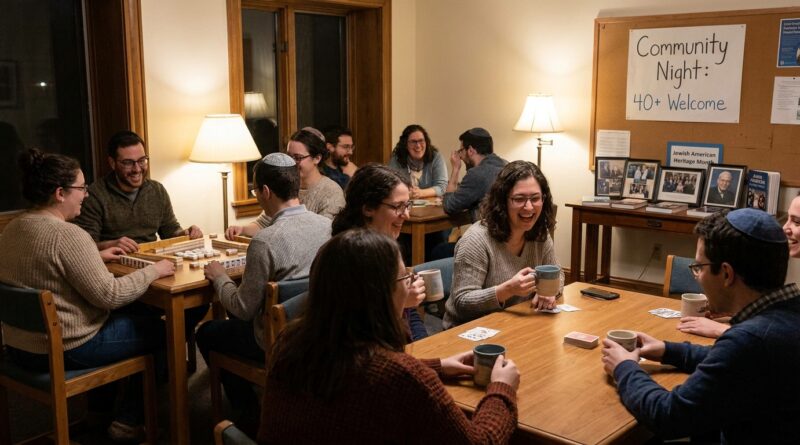
Tonight’s Over‑40 Jewish Meetups: The Quiet Game Nights And Coffee Circles Turning ‘There’s Nothing For Me Anymore’ Into Real Community
If you are over 40 and feel invisible on the Jewish calendar, your frustration makes sense. So many listings seem built for college students, “young professionals,” or parents pushing strollers. If you are not in one of those categories, it is easy to assume there is nothing for you except a formal lecture at 2 p.m. or another quiet night at home. But that is not the whole story. A quieter layer of Jewish community events for adults over 40 is still happening. You just usually have to know where to look. This week, that can mean a synagogue game night, a JCC coffee circle, an interfaith couples mixer with an older crowd, a book chat, or a low-pressure Shabbat dinner where nobody asks why you came alone. These events may not be flashy, but they are real. More important, they can turn “there’s nothing for me anymore” into actual community, one table, one conversation, one familiar face at a time.
⚡ In a Hurry? Key Takeaways
- Yes, Jewish community events for adults over 40 do exist, but they are often quieter and less promoted than youth-focused programs.
- Start with synagogue calendars, JCC newsletters, Facebook groups, and a quick email asking, “Which events tend to draw people 40-plus?”
- Low-key gatherings like coffee meetups, game nights, and volunteer events are often easier, safer, and less awkward than big mixer-style programs.
Why so many adults over 40 feel shut out
The complaint is remarkably consistent. Jewish life can seem sorted into neat bins. There are programs for students, singles in their 20s and 30s, young families, and seniors. If you are 43, 51, or 62 and do not fit any of those labels cleanly, you can feel like you slipped through a crack.
That feeling gets worse when every event photo shows the same thing. Babies. Name tags for “young leadership.” Rooftop happy hours. Or retirement seminars. Very little in the middle.
None of this means community disappears after 40. It usually means it gets less obvious, less branded, and more word-of-mouth. That is why the people finding connection right now are often not chasing the biggest event on the calendar. They are finding the smaller circles.
What over-40 friendly events actually look like this week
If you are expecting a giant neon sign that says “Jewish adults over 40, this way,” you may be waiting a while. The more common reality is a set of smaller, calmer gatherings that happen regularly and quietly.
Synagogue game nights
These may be listed as mahjong, canasta, board games, cards, or simply “social evening.” They are often more welcoming than formal networking events because there is a built-in activity. You do not have to invent conversation from scratch. You can just sit down, learn the rhythm of the table, and talk naturally.
JCC coffee circles and discussion groups
These are easy to overlook because the title can sound plain. That is exactly the point. They are usually low-pressure, daytime or early-evening gatherings where people show up to talk, not perform. If big social events make you tense, this is often the better entry point.
Shabbat dinners with a mixed-age crowd
Not every Shabbat dinner is a 20-somethings mixer. Some are community-wide, neighborhood-based, or hosted by smaller congregations where the age range is broader and more comfortable. Look for phrases like “community dinner,” “all are welcome,” or “hosted by members.”
Book clubs, film nights, and speaker salons
These can attract adults who want connection without the weirdness of a dating vibe. You come for the topic, but you stay because you start seeing the same people. That repeat contact matters.
Volunteer meetups
One of the best social shortcuts is doing something useful together. Packing food, helping at a pantry, or supporting a holiday project creates an instant shared purpose. If that route appeals to you, Passover Volunteering Near Me: How Local Chesed Events Turn Pre‑Holiday Stress Into Real Connection is a smart reminder that service often becomes community faster than small talk does.
How to spot the events that are actually a fit
This is where many people give up too soon. The listing may not say “over 40,” but the clues are often there.
Read the wording carefully
“Young adult” usually means not your event. “Family program” probably is not either unless you are bringing kids. But “community social,” “member mingle,” “coffee and conversation,” “havurah gathering,” and “game night” often pull a wider age range.
Check the event time
A Tuesday coffee at 10 a.m. may skew older. A 9:30 p.m. bar meetup probably will not. A 6:30 p.m. weeknight game night or Sunday morning bagel meetup often lands in a more mixed age bracket.
Email and ask directly
You do not need a complicated message. Try this: “Hi, I’m looking for Jewish community events for adults over 40. Which of your upcoming programs tend to draw that crowd?” Good organizers will answer honestly, and often warmly.
Look beyond the home page
The most public events are not always the most relevant ones. Dig into the synagogue bulletin, JCC email newsletter, Facebook events tab, and local Jewish federation calendar. That is often where the quieter gatherings live.
Why the quiet events often work better
Big branded events can be fun, but they can also be exhausting. Loud room. Fast intros. Everyone trying to look like they belong. If you already feel rusty or left out, that setting can make things worse.
Smaller over-40 friendly gatherings do something different. They lower the stakes. There is room to be new. Room to be a little awkward. Room to come by yourself without feeling like the only person who did.
That matters more than slick marketing. Community is not built by perfect event design. It is built when somebody remembers your name the second time you show up.
If you want to go tonight, start here
Here is a practical way to find something fast.
1. Search local calendars with the right wording
Use terms like “Jewish community events for adults over 40,” “Jewish social group 40+,” “synagogue game night,” “JCC coffee group,” and your city name.
2. Check three places, not one
Look at a synagogue site, a JCC calendar, and a local Jewish Facebook group or federation page. One source is rarely enough.
3. Pick the least intimidating option
Do not force yourself into the biggest room if that is not your style. A coffee meetup or game table counts. In fact, it may be the better move.
4. Go for repeatability
One-off events are fine, but recurring gatherings are gold. Weekly or monthly circles are how strangers become familiar.
5. Bring one simple opener
You do not need charm-school material. Try, “Have you been to this before?” or “How did you hear about this group?” That is enough.
What organizers keep missing
There is a real lesson here for synagogues, JCCs, and Jewish nonprofits. Adults over 40 are not asking for luxury programming or special treatment. They are asking not to disappear.
A lot of people in this age group are single, divorced, widowed, child-free, newly relocated, interfaith, caregiving for parents, or simply in a life stage that does not match the usual community categories. They want Jewish connection without being shoved into “young” or “senior” boxes.
Even small changes help. Clearer labeling. Mixed-age community dinners. More evening options. Better promotion for game nights and coffee circles. A person who feels seen is much more likely to come back.
At a Glance: Comparison
| Feature/Aspect | Details | Verdict |
|---|---|---|
| Game nights and coffee circles | Low-pressure, easy conversation, often mixed or 40-plus crowds, usually recurring | Best starting point for most people |
| Large mixer-style events | More visible and energetic, but often skew younger and can feel intimidating | Worth trying only if the description clearly fits your age group |
| Volunteer gatherings | Shared purpose reduces awkwardness and creates organic connection | Excellent option if social events feel forced |
Conclusion
If the Jewish world has felt like it moved on without you after 35, you are not being dramatic. A lot of adults over 40 are looking at the same packed calendars and thinking, “None of this is really for me.” But the answer is not always that nothing exists. It is often that the most welcoming options are smaller, quieter, and badly advertised. This week, that might be a synagogue mahjong Monday, a JCC coffee circle, a mixed-age Shabbat dinner, or a volunteer shift where conversation happens naturally. Those are not second-best events. For many people, they are the doorway back in. And the more these gatherings are seen and talked about, the more organizers may finally remember a basic truth. Jewish belonging does not expire at 35.