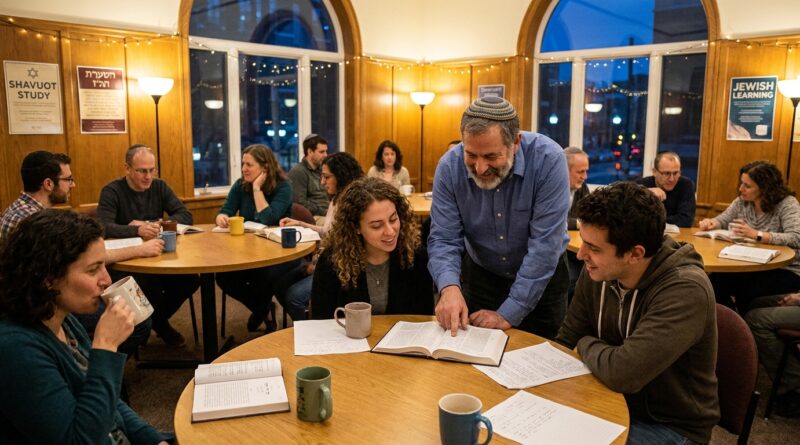
Tonight’s Pre‑Shavuot Learning Nights: The Late‑Evening Study Sessions Quietly Turning ‘I Haven’t Opened a Text Since Hebrew School’ Into Real Curiosity
If you have ever typed “what’s happening tonight” and then closed three synagogue event pages because they all sounded like graduate school, you are not alone. A lot of Jews want a way back into learning before Shavuot, but the wording can make it feel like you need years of background just to walk in the door. The good news is that many pre Shavuot Jewish learning events near me are actually built for drop-ins, beginners, rusty former Hebrew school kids, and curious adults who just want one thoughtful hour.
That is the quiet gift of these late-evening study sessions. They are often less formal than they sound, more welcoming than their flyers suggest, and easier to try than committing to a class series. You do not need to know how to read Hebrew. You do not need a perfect Jewish resume. You just need to show up, grab coffee, find a chair, and let yourself be a beginner again. For plenty of people, that one small step turns “Judaism felt closed to me” into real curiosity.
⚡ In a Hurry? Key Takeaways
- Yes, there are beginner-friendly pre Shavuot Jewish learning events near you, even if the event description sounds advanced.
- Look for words like “all levels,” “open to the community,” “conversation,” “text study in translation,” and “drop in.”
- You can attend for just one session. That still counts, and it helps local communities fill rooms with new faces tonight.
Why so many people feel shut out of Jewish learning
The problem is not just lack of interest. It is packaging.
A flyer says “Tikkun Leil Shavuot” and lists teachers, tractates, and topics that sound intense. If you have not opened a Jewish text since middle school, that can feel like walking into the middle of a movie after missing the first hour.
So people do what people always do when something feels slightly embarrassing. They skip it. They tell themselves maybe next year.
That is a shame, because many of these nights are meant for exactly those people. Rabbis and educators often want a mixed room. They want regulars, skeptics, beginners, empty nesters, college kids home for the weekend, and adults who vaguely remember being bored in Hebrew school but suspect there might be more here now.
What a pre-Shavuot learning night actually feels like
Usually, it is much more relaxed than the title suggests.
You are rarely expected to know the basics
Most accessible sessions provide source sheets in English, explain the context, and leave room for questions. Good teachers know not everyone in the room has the same starting point.
You can come for one class, not the whole night
This matters. A lot of people assume a “night of learning” means arriving at 8 p.m. and staying until midnight. Not true. Many people come for one session, maybe two, then head home.
The social part matters too
There is usually coffee. Sometimes cheesecake. Often a chance to meet one rabbi, one educator, or one other person who also came alone. That can be the whole win for the night.
If you are attending with children or looking for something more hands-on for younger ages earlier in the day, it is worth checking Today’s Shavuot Pop‑Ups For Kids: The Hands‑On Torah Parties Quietly Turning Cheesecake Into Jewish Memory. It pairs nicely with an adult learning plan later tonight.
How to find pre Shavuot Jewish learning events near me without already being on the right email list
This is where most people get stuck. The events exist, but they are scattered.
Start with the obvious, then go one layer deeper
Search your city or neighborhood plus “Shavuot learning,” “Tikkun Leil Shavuot,” “Jewish learning night,” “community Shavuot event,” or “adult education Shavuot.”
Then check:
Synagogue websites
JCC calendars
Hillel pages, even for public events
Federation community calendars
Local Jewish Facebook and Instagram pages
Chabad event pages
Independent minyan newsletters and social posts
Do not let denominational labels scare you off
If a Reform, Conservative, Orthodox, Reconstructionist, or independent group is hosting, read the event details before assuming it is not for you. Some of the most accessible sessions happen in places people almost skipped because they thought, “That is probably not my crowd.”
Read for these friendly signals
Look for phrases like:
Open to all
No background needed
Texts in translation
Beginners welcome
Community-wide event
Drop in for any session
Discussion-based learning
Come for one class or stay all evening
Green flags that tell you a session is truly beginner-friendly
Not every event is equally easy to enter cold. Here is how to tell.
Green flag 1: The title sounds human
“What does it mean to receive Torah now?” is usually easier to enter than a session title packed with untranslated Hebrew or academic references.
Green flag 2: There is a clear teacher bio
If the listing tells you who is teaching and what they care about, that usually means they are thinking about real people attending, not just insiders.
Green flag 3: The schedule includes variety
A good night often mixes serious text study with culture, ethics, current issues, spirituality, food, art, or discussion. That variety is helpful if you are easing back in.
Green flag 4: The event says “community” more than “membership”}
If the wording makes it clear outsiders are welcome, believe it.
Questions you are allowed to ask before going
You do not need to guess.
Email or message and ask:
Is this okay for someone with very little background?
Can I come for just one session?
Will texts be available in English?
Is registration required?
What is the best session for a first-timer?
Is there a cost?
These are normal questions. Good hosts are happy to answer them.
If you feel awkward showing up alone, use this simple plan
This works for tech support and Jewish events alike. Reduce friction.
Pick one session, not the whole night
Do not think in terms of “becoming a person who studies all night.” Think, “I can try one 50-minute class.”
Arrive 10 minutes early
It is easier to settle in before the room fills. You can ask where beginners usually sit, where the source sheets are, and whether there is a session people recommend for newcomers.
Use one sentence to break the ice
Try: “I haven’t done this in years, is this a good first session?”
You will be shocked how often the answer is warm and immediate.
What kinds of topics tend to reconnect adults fastest
If you have a choice, pick the topic that sounds alive to you, not the one you think you are “supposed” to choose.
Often the best re-entry topics are:
The Ten Commandments and modern life
Why Shavuot matters beyond cheesecake
Jewish ideas about responsibility and community
Ruth, belonging, and choosing Jewish life
Work, rest, obligation, and burnout
How argument works in Jewish tradition
These topics give people a way in. They feel relevant. They invite thought instead of testing memory.
What to ignore so you do not talk yourself out of going
Ignore the fear that everybody else knows more than you. Some do. Many do not.
Ignore the assumption that if a teacher is smart, the room will be unfriendly. Often the opposite is true.
Ignore the old Hebrew school memory where learning felt forced, childish, or flat. Adult learning can feel very different. More open. More honest. More connected to actual life.
At a Glance: Comparison
| Feature/Aspect | Details | Verdict |
|---|---|---|
| Best event wording | “All levels,” “texts in English,” “drop in,” and “open to the community” are strong signs of an accessible night. | Good pick for first-timers |
| Time commitment | Most people do not need to stay for the entire program. One session is enough to get a real taste. | Low pressure |
| Value tonight | You get a concrete way back into Jewish life, and local communities get fuller rooms and more mixed participation. | Worth doing |
Conclusion
Tonight does not have to be the night you suddenly become an expert. It can just be the night you walk into a room, listen, ask one question, and remember that Jewish learning was never supposed to belong only to people who already know the vocabulary. That is why this moment matters. We are in the quiet ramp-up to Shavuot, when synagogues and JCCs post last-minute learning programs that almost nobody outside their email list ever hears about. Finding and sharing these accessible sessions gives disconnected Jews a real option for tonight, and it helps smaller communities fill the room with people who might otherwise only show up for holidays or social events. Show up for one hour. Meet a rabbi or educator. See what it feels like to learn as a grown-up, not as a bored kid in Hebrew school.