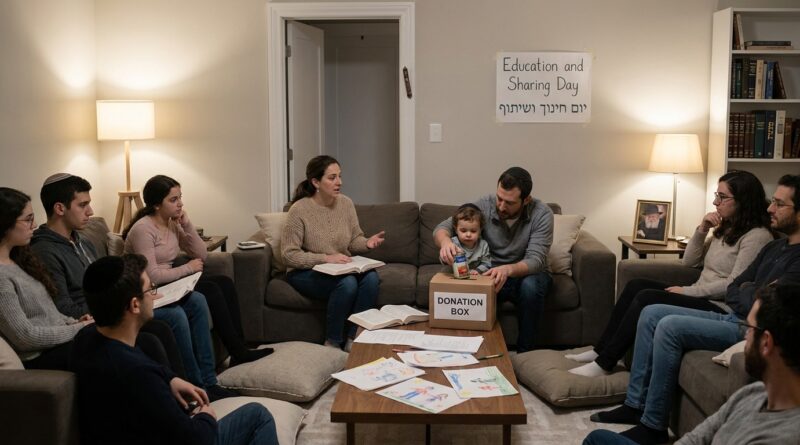
Education and Sharing Day 2026: The Quiet Jewish-Inspired Holiday That’s Suddenly Everywhere This Week
If you are feeling worn down by Jewish news, school stress, Passover prep, and the general fog of trying to keep everyone afloat, you are not imagining it. A lot of people want something real to do this week that is hopeful, Jewish, and manageable. That is why Education and Sharing Day 2026 is suddenly getting more attention. It is a federally recognized day in the United States, marked each year around 11 Nisan, the Hebrew birthday of the Lubavitcher Rebbe. It is not a major synagogue holiday. There is no long service to attend, no special food to cook, and no fixed ritual to get right. Honestly, that is part of the appeal. It gives families, schools, synagogues, and neighborhoods room to create a simple hour of learning, kindness, and community. If “Jewish continuity” has started to sound abstract, this is the opposite. It is concrete. You can do it tonight, after work, with ten people or two.
⚡ In a Hurry? Key Takeaways
- Education and Sharing Day Jewish meaning 2026 is simple: a Jewish-rooted, nationally recognized day focused on moral education, shared values, and acts of generosity.
- You can mark it with a one-hour gathering that includes a short Jewish text, one honest conversation, and one small act of giving.
- Because there are no fixed rituals, it is flexible, low-pressure, and a good fit for people managing fatigue, security concerns, caregiving, or Passover prep.
What Education and Sharing Day actually means in 2026
Education and Sharing Day can sound vague at first. The name almost feels like it belongs on a school flyer. But its Jewish meaning is more specific than that.
In the United States, presidents annually issue a proclamation recognizing Education and Sharing Day around 11 Nisan. The day is associated with the Rebbe, Rabbi Menachem Mendel Schneerson, whose public message often stressed that education is not only about facts and grades. It is also about character, moral responsibility, and care for other people.
So when people search for “Education and Sharing Day Jewish meaning 2026,” the shortest honest answer is this: it is a public-facing, Jewish-inspired day that asks what kind of humans we are raising and what kind of neighbors we are becoming.
That matters right now. People are tired. Communities are carrying grief, anxiety, and a lot of logistical overload. A day built around learning and sharing, without heavy ritual demands, meets people where they are.
Why this quiet holiday is suddenly everywhere this week
Part of it is timing. The day lands as many Jews are still emotionally raw from Yom HaShoah and already deep into Passover planning. That is not exactly a recipe for launching into something elaborate.
But Education and Sharing Day does not ask for elaborate. It asks for intention.
That is why it is spreading in schools, community centers, synagogues, libraries, and family WhatsApp groups. It gives people a way to do something Jewish and constructive without adding another huge obligation. If you want more background on why it is showing up in community life right now, this piece on Education and Sharing Day 2026: The Overlooked Jewish-Inspired Holiday That’s Quietly Shaping Community Life Right Now lays out that shift clearly.
What makes it different from a regular Jewish holiday
No fixed synagogue ritual
There is no standard prayer service you must attend. No required blessings. No “right” menu. That can feel unfamiliar, but also freeing.
It works in public and private spaces
You can mark it in a classroom, at a synagogue, around a kitchen table, in a workplace lunchroom, or at a local park.
It is values-first
The focus is not ceremonial precision. The focus is education, ethical growth, and generosity. That makes it especially accessible for interfaith families, secular Jews, public institutions, and people who feel spiritually rusty.
A one-hour gathering kit you can actually use
If you want a concrete way to mark the day, here is a simple format that works for families, teachers, youth groups, adult education circles, or neighbors.
Minute 0 to 10: Welcome and ground rules
Open with one sentence: “We are here for Education and Sharing Day to learn one thing and share one thing.”
Set an easy tone. Phones down if possible. Everyone gets a chance to speak. No speeches required.
Minute 10 to 20: Read one short Jewish text
Keep it brief. Good options include:
- Pirkei Avot 1:2, on Torah, service, and acts of kindness
- Pirkei Avot 1:14, “If I am not for myself, who will be for me?”
- A short teaching about educating the heart, not just the mind
Ask two questions only. What stands out? What feels hard about this right now?
Minute 20 to 35: Share one real-life story
Invite each person to name a teacher, mentor, parent, coach, rabbi, counselor, or friend who shaped them. Not a polished tribute. Just a real memory.
This part tends to work because it is personal without being too demanding. People often have more to say than they expected.
Minute 35 to 50: Do one act of generosity
Pick one small action you can complete on the spot:
- Write thank-you notes to teachers
- Collect a small donation for a local food pantry
- Put together snack bags for first responders or shelter staff
- Send gift cards to a family under stress
- Make cards for isolated seniors
The point is not scale. The point is movement.
Minute 50 to 60: Close with one commitment
Go around and finish this sentence: “This week, I will share…”
That could mean sharing time, food, attention, knowledge, money, or patience.
If you are a parent, teacher, or rabbi, keep it boring in the best way
Here is some friendly advice. Do not overproduce this.
You do not need custom graphics, branded bookmarks, or a seven-part curriculum. Most people are already stretched thin. The best version of Education and Sharing Day in 2026 is the one that actually happens.
Think folding chairs, cookies, a photocopied text, and a simple ask. That is enough.
Ideas for different settings
For families with kids
Ask each child to draw a picture of someone who teaches them. Then help them deliver a note or treat to that person. End by putting coins in a tzedakah box.
For a classroom
Read a short quote about kindness or responsibility. Have students talk about one way learning should help people, not just help test scores. Then do a class service project.
For a synagogue or chavurah
Host a short text study and community drive for a local school, pantry, or immigrant support group. Keep it to one hour, maybe right after minyan or before evening programs.
For exhausted adults
Tea. A short source sheet. One check-in question. One donation link. Done.
Why the “sharing” part matters so much this year
Education alone can stay trapped in our heads. Sharing pushes it outward.
In practical terms, that means the day is not just about admiring Jewish values. It is about using them. You learn something Jewish, then you pass some good into the world. That rhythm is part of what makes the day feel useful instead of symbolic.
And right now, useful is underrated.
What not to do
- Do not turn it into a debate about denominational politics.
- Do not make attendance feel like a guilt test.
- Do not pick a project so ambitious that nobody finishes it.
- Do not assume everyone is emotionally ready for a heavy program.
A soft on-ramp is the whole point.
How to explain it to someone who has never heard of it
Try this: “It is a national day with Jewish roots that focuses on education, character, and doing one good thing for others.”
That is plain English. It also happens to be true.
At a Glance: Comparison
| Feature/Aspect | Details | Verdict |
|---|---|---|
| Religious structure | No fixed liturgy or required synagogue ritual. Communities can shape their own program. | Very accessible |
| Time commitment | Can be meaningfully observed in about one hour with text, conversation, and one act of generosity. | Low-friction and realistic |
| Best use this week | A hopeful, local Jewish moment during a week filled with grief, stress, and Passover logistics. | Worth doing |
Conclusion
Education and Sharing Day 2026 does not ask you to become a different person by tonight. It just asks you to turn a little attention into learning, and a little learning into kindness. In the last 24 hours, Jewish and civic calendars in the United States have quietly been flagging this annual day around 11 Nisan. Because it is not a liturgical chag and comes with no fixed synagogue rituals, it creates a rare opening. You can make it local. You can make it small. You can make it real. At a moment when many people feel spiritually depleted, emotionally overloaded, and busy with holiday prep, that matters. A one-hour gathering with a short Jewish text and one concrete act of generosity may sound modest. Good. Modest is exactly what makes it possible. And possible is what helps a calendar line become a living Jewish moment, one that builds heart, honors Jewish wisdom in public, and gives families, students, and neighbors something hopeful to do right now.