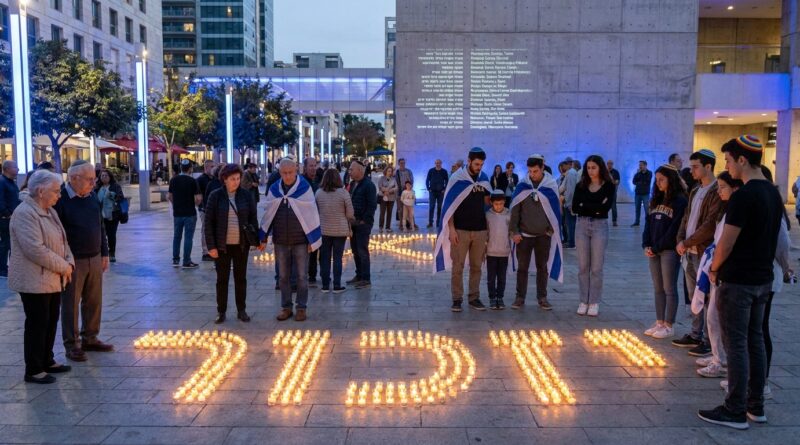
Yom HaZikaron 2026: How Tonight’s Memorial Ceremonies Are Quietly Re‑Stitching a Frayed Global Jewish Community
You may be walking into Yom HaZikaron 2026 already worn out. That makes sense. For months, many Jews have been carrying too much at once. Grief for Israelis killed in war or terror. Fear after antisemitic incidents closer to home. Anger at the endless online shouting. And a strange loneliness, even while being flooded with Jewish and Israel content all day long. So if tonight’s community ceremony feels both necessary and hard, you are not doing it wrong. The point is not to prove how much pain you can absorb. The point is to show up in a way that is honest, bearable, and human. A good Yom HaZikaron 2026 community ceremony can do something social media cannot. It can put actual people in the same room, lower the volume, and help a frayed global Jewish community remember that mourning is not only private. It is also something we do together, carefully, and in real time.
⚡ In a Hurry? Key Takeaways
- Tonight’s Yom HaZikaron ceremony does not need to be all or nothing. Choose a format that matches your emotional bandwidth.
- If a big public program feels too heavy, attend for one section, go with a friend, or join a smaller community gathering instead.
- The most useful goal is not political agreement. It is shared presence, basic care, and one small follow-up act after the memorial ends.
Why tonight feels heavier than usual
Yom HaZikaron is always intense. That is built into the day. It asks people to stop, remember, and sit with loss.
But 2026 is not happening in a normal emotional climate. Many Jews are carrying fresh grief and old grief at the same time. Some feel closely tied to Israel’s losses. Some feel guilty for being less connected than they think they should be. Some are scared in their own cities and campuses and workplaces. Some are simply tired.
That mix matters. It changes what a community ceremony feels like. A memorial event is no longer just about national remembrance. For many diaspora Jews, it has quietly become a place to ask, “Am I still part of this people when I feel broken, angry, numb, or unsure?”
The answer is yes. You do not need perfect language or perfect politics to be present for the day.
How to choose the right kind of Yom HaZikaron 2026 community ceremony
Not every ceremony is built the same. That is good news. It means you can pick the version that fits your actual capacity tonight.
If you need structure and tradition
A synagogue or federation ceremony may work best. These often include prayers, readings, moments of silence, songs, and names of the fallen. If you want the container to hold you, rather than having to make emotional decisions on the fly, this can help.
If you need something smaller and less formal
Look for a local JCC, school, youth movement, or neighborhood gathering. Smaller memorial circles can feel more human and less performative. They may leave more room for quiet conversation before or after.
If you are afraid of getting overwhelmed
Give yourself permission to attend only part of the program. Go for the opening siren, the memorial prayer, or the candle-lighting, then leave. That still counts. Showing up for 20 honest minutes is better than forcing yourself through two painful hours and regretting it.
If public space feels unsafe right now
Choose a ceremony with clear security, known organizers, and a location where you feel physically comfortable. Emotional openness is hard enough. You should not have to ignore basic safety instincts to prove commitment.
You do not have to pass a political test to mourn
One reason people avoid community events this year is simple. They are worried the room will turn into a referendum on identity, ideology, or Israel literacy.
Sometimes that worry is fair. But Yom HaZikaron is not supposed to be an audition. It is a day of memory.
If you attend, you are allowed to hold more than one truth at once. You can grieve Israelis killed in war or terror and also feel exhausted by conflict language. You can care deeply about Jewish peoplehood and still feel uneasy in spaces that expect total agreement. You can be present for national loss while also carrying diaspora fear that has nothing to do with slogans and everything to do with daily life.
A healthy Yom HaZikaron 2026 community ceremony makes room for this complexity without flattening it. It does not demand that every attendee narrate their grief in exactly the same way. It asks them to stand in the same room and recognize that loss has made all of them smaller and more fragile than they want to admit.
How to make tonight emotionally survivable
This is where people often get stuck. They think the choice is either full immersion or total avoidance. It is not.
Set one limit before you go
Pick one boundary in advance. You will stay for one hour. You will not read comment sections afterward. You will sit near the exit. You will skip the post-event debate. One small limit can keep the night from spilling into something unmanageable.
Go with one person
Do not underestimate the value of having a buddy. You do not need a deep conversation partner. You just need one person who knows where you are emotionally and can walk in and out with you.
Decide your role ahead of time
Are you there to listen? To say kaddish? To support a friend? To hear Hebrew songs that connect you to family memories? To avoid being alone? Any of those are valid. Naming your reason lowers the pressure.
Have an exit ritual
When the ceremony ends, do not go straight back to doomscrolling. Walk around the block. Call someone safe. Drink water. Light a candle at home. Write down one name, one line, or one feeling you want to carry forward. Close the night on purpose.
What these ceremonies are quietly doing for the wider Jewish community
The most interesting thing about a Yom HaZikaron 2026 community ceremony is not only what happens on stage. It is what happens in the room.
People who have spent months arguing online, or avoiding each other, suddenly share the same silence. People who feel disconnected from Israel hear a song or prayer and remember they are not actually outside the story. Israeli expats, American Jews, French Jews, British Jews, secular Jews, synagogue regulars, and people who only show up three times a year find themselves standing shoulder to shoulder for a few minutes without having to solve everything.
That matters more than it sounds.
Communities do not get repaired only by statements and strategy. They also get repaired by repetition. A siren. A memorial prayer. A candle. A hand on a shoulder. A room that says, “You are not the only one carrying this.”
Then, if people are ready, the next step can be lighter and more social. That is part of why the transition into Israeli Independence Day matters. We are already seeing this in local spaces, as described in Yom HaAtzmaut 2026: How Local JCC Parties Are Quietly Becoming The New Blueprint For Jewish Unity. Memorial and celebration are not opposites in Jewish communal life. Often, one makes the other possible.
How to honor both Israeli and diaspora pain without collapsing them into one thing
This is delicate, but it matters.
Israeli bereavement and diaspora antisemitism are not identical experiences. They should not be blended into a single generic sadness. But they do live beside each other right now in the hearts of many Jews. Tonight can hold both without pretending they are the same.
One useful way to think about it is this. Yom HaZikaron centers those killed in Israel’s wars and acts of terror. That is the core. Around that core, diaspora Jews may also notice what the year has done to their own sense of safety, belonging, and connection. That secondary layer does not replace the day’s meaning. It helps explain why so many people are arriving emotionally raw.
If a ceremony acknowledges that with care, it can feel like a relief instead of a distraction.
Turn one memorial night into one act of mutual care
The real test of tonight is not whether the program was moving. It is whether it changes what happens tomorrow.
Keep it small. Small is realistic. Realistic is better than grand.
Three simple follow-up ideas
Text one person you saw there and ask how they are doing.
Make a plan to attend a community event this week, even a low-key one.
Offer a ride, a meal, or company to someone who looked alone.
If you do that, the ceremony stops being only a hard night. It becomes the start of renewed community muscle. Not dramatic unity. Just basic Jewish reliability. The kind where people show up, check in, and stay in touch.
If you cannot attend at all
That is also allowed. Sometimes the most honest choice is to mark the day privately.
You can pause for a minute of silence. Read a memorial prayer. Light a candle. Listen to one song. Donate in memory of victims of terror or fallen soldiers. Call a family member who needs to feel less alone tonight.
The point is not performance. The point is witness.
If public grief feels impossible this year, choose a smaller form. Judaism has always had room for both communal ritual and personal acts of remembrance.
At a Glance: Comparison
| Feature/Aspect | Details | Verdict |
|---|---|---|
| Large public ceremony | More formal, more collective energy, often includes music, readings, and strong ritual structure. | Best if you want to feel held by a wider community. |
| Small local gathering | Lower intensity, more personal, easier to connect with people before and after. | Best if you need gentler entry and real conversation. |
| Private observance at home | Maximum control, less overstimulation, but less communal support in the moment. | Best if your emotional bandwidth is low, but pair it with one outreach step if you can. |
Conclusion
Yom HaZikaron begins this evening, and for many Jews the hardest part is not deciding whether the day matters. It is deciding how to meet it without falling apart or shutting down. A Yom HaZikaron 2026 community ceremony can help if you approach it like a person, not a symbol. Choose the kind of gathering that fits your actual capacity. Let yourself honor Israeli loss without pretending your own diaspora fear and exhaustion are irrelevant. Skip the loyalty tests. Look for one real human connection. Then carry that forward into one modest act of care. In a year when too many people are either fighting online or quietly disappearing from communal life, showing up tonight in a small, honest, manageable way is not a cop-out. It is a repair job. Maybe not a dramatic one. But real communities are often re-stitched exactly like this, one room, one ritual, and one gentle follow-up at a time.