Today’s Jewish Heritage Month City Proclamations: The Quiet Civic Rituals Turning ‘We’re Invisible Here’ Into Public, On-the-Record Pride
It is frustrating to watch Jewish American Heritage Month show up in national headlines while your own town still feels vague about Jewish life. Maybe there is a festival once a year. Maybe there are security updates after an incident. But the everyday civic message can still feel thin, like Jews are discussed as an abstract minority instead of neighbors with a real local story. That is why this week’s wave of Jewish American Heritage Month city proclamation 2026 moments matters more than it may seem at first glance. When a mayor, council, or county board reads a proclamation into the record, names antisemitism clearly, and recognizes Jewish residents as part of the city’s shared story, that is not just ceremony. It is a public marker. It says, on paper and out loud, that Jewish life belongs here. And when local Jews show up for it, even quietly, it stops being symbolic and starts becoming part of the town’s memory.
⚡ In a Hurry? Key Takeaways
- Jewish American Heritage Month proclamations matter because they put Jewish presence, local history, and concern about antisemitism into the official public record.
- If your city is issuing one, treat it like a small community event. Show up, bring a friend, sign up for public comment if you can, and take photos people can share later.
- These moments are low-cost but important. They can shape how schools, libraries, and local leaders respond to Jewish visibility and safety later on.
Why these proclamations hit a nerve
A lot of people are tired of broad diversity language that never quite lands anywhere real. You hear nice words. You see a social media post. Then daily Jewish life in town still feels blurry.
That is what makes a city proclamation different. It is specific. It is dated. It is read aloud in a room where decisions get made. Often, it includes plain recognition of Jewish contributions, local Jewish institutions, and the rise in antisemitism that many residents are already feeling in their bones.
It is a small civic ritual. But small rituals matter because they tell a community who counts.
What a proclamation actually does
A proclamation will not fix everything. It will not erase hostility. It will not suddenly make every school or library get Jewish inclusion right.
Still, it does three useful things.
It puts Jewish life on the record
Once a city council or mayor issues a statement, there is now an official document saying Jewish residents are part of the local story. That matters later. When a question comes up about curriculum, public programming, holiday visibility, permits, security coordination, or funding, there is now a paper trail showing that the city already recognized this community as part of the civic whole.
It makes the abstract feel local
People often understand Jewish life in national terms only. Big news. Big conflict. Big stereotypes. A proclamation can pull that down to street level by naming local synagogues, family businesses, immigrant stories, Holocaust survivors, educators, veterans, artists, or volunteers who helped build the city.
It gives neighbors a low-pressure way to show support
Not everyone is ready to attend a full program, panel, or interfaith event. But many people will come to a council meeting for ten minutes, clap, and learn something. That counts. It helps widen the circle.
The part nobody should ignore: being in the room matters
This is where the whole thing shifts from paperwork to public life.
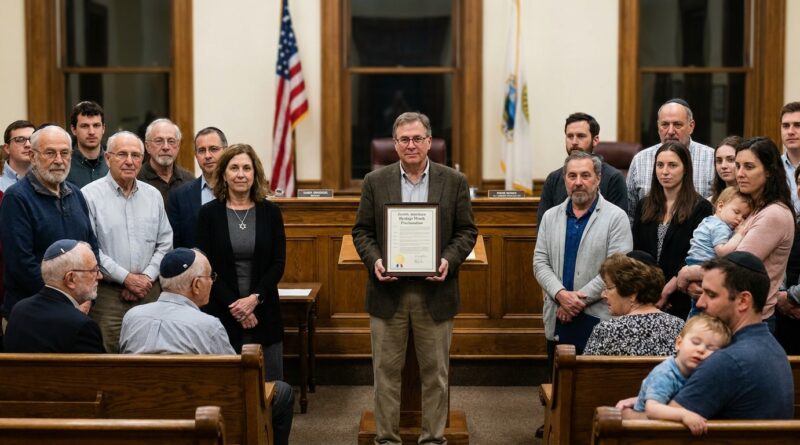
If nobody Jewish attends, the proclamation can pass and disappear. It sits in a folder, maybe gets a photo op, then fades. But if local Jews are there, standing together, speaking during public comment, bringing teens, clergy, grandparents, educators, and allies, the moment becomes visible. It becomes harder to treat Jewish heritage as theoretical.
You do not need a polished speech. You do not need a crowd of 200. Even a handful of people changes the room.
One person can thank the council. Another can mention a family story tied to the city. A rabbi can invite residents to learn more. A student can say what it means to hear Jews named as part of the local “we.” That is how an ordinary agenda item becomes a civic memory.
How to turn a proclamation into a micro-event
If this sounds familiar, it connects naturally with the rise of small, local Jewish Heritage Month gatherings. We are seeing more communities use quick, doable formats instead of waiting for one giant flagship event. That is the same spirit behind Today’s Jewish American Heritage Month Pop‑Ups: The Local Micro‑Events Quietly Reclaiming May For Jewish Stories. A city proclamation can work exactly that way.
Before the meeting
Check the city council, mayor’s office, or county board calendar. Search for agenda packets, ceremonial items, or proclamations. If you see a Jewish American Heritage Month city proclamation 2026 item, do not assume someone else will handle turnout.
Text people directly. Keep it simple. “City Hall is recognizing Jewish American Heritage Month Tuesday at 7. Can you come for 20 minutes?”
That works better than a vague blast asking for support.
During the meeting
Sit together if possible. Sign up for public comment if the rules allow it. Keep remarks short, warm, and local. Thank officials for naming antisemitism clearly if they do. Mention one real local contribution Jewish residents have made. Invite the city to keep going with school, library, or cultural programming.
Photos matter too. Not vanity photos. Record photos. A group shot with the proclamation tells everyone later that Jewish life was present in the room.
After the meeting
Post the photos. Share the text of the proclamation. Thank the officials by name. Tag local institutions, schools, museums, interfaith groups, and neighborhood pages. Then suggest one follow-up action, like a library display, walking tour, student project, or speaker night.
This is how one ceremonial minute becomes a month of actual visibility.
What to listen for in a strong proclamation
Not all proclamations are equally useful. Some are generic. Others are thoughtful and grounded.
Good signs
A strong proclamation usually does a few things well. It names Jewish American Heritage Month clearly. It mentions local Jewish history or contributions. It states concern about antisemitism in plain English. It invites residents to learn more, attend events, or celebrate the community.
Weak spots
If the language is so broad that “Jewish” appears only once, or if it avoids any mention of current antisemitism, it may feel safe but thin. That does not mean you reject it. It means you use public comment and follow-up to add the missing local texture.
Why this matters later, not just this week
This is the quiet part people miss. A proclamation is not only about feeling seen in the moment. It can help shape what comes next.
When schools plan heritage lessons, local leaders already have a public reason to include Jewish stories. When libraries build displays or author events, there is a recent civic statement to point to. When Jewish institutions ask for attention to safety concerns, the city cannot honestly say the community has not been publicly recognized.
That does not guarantee results. But it makes future asks less isolated.
It also helps neighbors understand that Jews are not outsiders appearing only in moments of crisis. Jews are residents, volunteers, taxpayers, donors, teachers, business owners, and families in the town right now.
If your city has not done one yet
You can still start.
Reach out to a council member, mayor’s office, human relations commission, or clerk. Ask whether the city plans to issue a Jewish American Heritage Month proclamation 2026. Offer sample language. Keep the ask friendly and practical.
You do not need to make it dramatic. You are not asking for special treatment. You are asking the city to recognize a federally recognized heritage month in a way that reflects local residents and current reality.
If they say it is too late for this year, ask for a council acknowledgment, social post, library partnership, or next-year commitment. Small openings count.
At a Glance: Comparison
| Feature/Aspect | Details | Verdict |
|---|---|---|
| Official recognition | A proclamation puts Jewish heritage, local history, and concern about antisemitism into city records and meeting minutes. | Worth showing up for |
| Community turnout | Even a small group of Jewish residents and allies can turn a ceremonial item into a visible, shared local moment. | Most important ingredient |
| Long-term value | Creates a public reference point for future talks about schools, libraries, cultural inclusion, and community safety. | Quietly powerful |
Conclusion
Across the U.S., mayors and councils are issuing Jewish American Heritage Month proclamations this week that explicitly name antisemitism, celebrate local Jewish stories, and invite residents to learn and show up. Those moments get written into public record, but they only become living heritage when real Jews are in the room, speaking from the mic line, or even just standing together in the back row. If your town has one on the calendar, treat it as more than a formality. It is a chance to root Jewish life in the civic story of your city, remind neighbors that Jews are part of the local “we,” and build quiet long-term credibility the next time schools, libraries, or city budgets affect Jewish safety and visibility. Sometimes public pride starts with a very ordinary Tuesday night at City Hall.