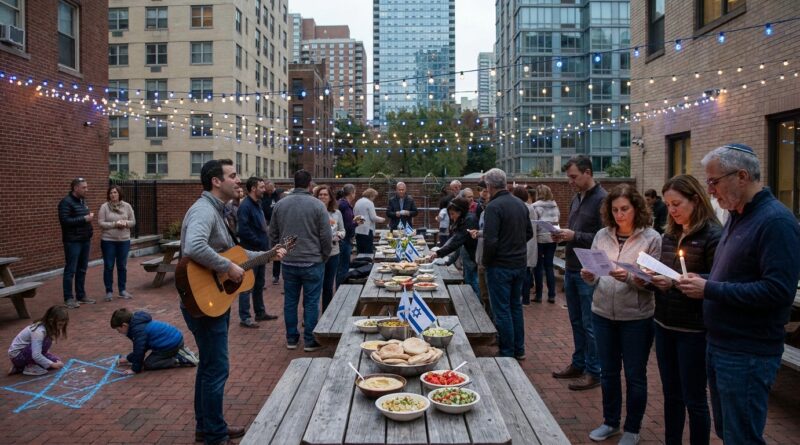
Yom HaAtzmaut 2026 Tonight: The Local Jewish Street Parties Quietly Rewriting Israel’s Independence Day
A lot of people are heading into Yom HaAtzmaut tonight with a knot in their stomach. They want to feel pride, relief, connection, maybe even a little joy. But giant rallies, loud music, and all-or-nothing slogans can feel wrong in a year that still hurts. If that sounds like you, you are not alone. Across Jewish communities, the most meaningful Israel Independence Day gatherings in 2026 are not always the biggest ones. They are the quieter street parties, block dinners, backyard singalongs, and community center meetups where people can show up as they are. That is the shift worth noticing tonight. If you are wondering how to celebrate Yom HaAtzmaut 2026 in my local Jewish community, the answer may be smaller, softer, and more human than you expected. You do not need to choose between forced cheer and staying home. There is a middle path, and many communities are building it in real time.
⚡ In a Hurry? Key Takeaways
- Tonight’s most workable Yom HaAtzmaut celebrations are small, local, and low-pressure, not necessarily big public rallies.
- Start with a simple format: food, one shared ritual, one song or story circle, and clear room for mixed emotions.
- Keep it welcoming and emotionally safe. Tell people they can come for 20 minutes or two hours, and nobody has to perform joy.
Why small local parties are landing differently this year
Yom HaAtzmaut usually comes with a script. Flags. Dancing. Israeli music turned up too loud. A quick pivot from memorial pain to national celebration. For many people in 2026, that script feels harder to step into.
The last year has left communities tired and divided. Some people are grieving. Some are angry. Some feel fiercely protective of Israel but deeply uneasy about public displays that flatten everything into one emotion. Others still want celebration, but not the kind that demands they ignore the complexity in the room.
That is why local Jewish street parties are quietly becoming the better fit. They are not trying to solve every argument. They are giving people a place to stand together anyway.
What these gatherings look like in real life
The successful ones are usually pretty simple. A synagogue parking lot with folding tables and blue-and-white paper lanterns. A Jewish federation side street closed off for two hours. A school courtyard with Israeli snacks, acoustic music, and a table where people write notes to loved ones in Israel. A neighborhood potluck where kids wave flags while adults actually talk.
The key difference is tone. These events do not demand one emotional register. They make room for warmth without pretending everything is fine.
Common traits of the best community events tonight
They are easy to join. No need for formal dress, tickets, or perfect politics.
They are short. Ninety minutes to two hours is often enough.
They are personal. Real hosts greet people. Names are used. Faces matter.
They mix joy with honesty. A blessing, a moment of reflection, then food and music.
They give people an exit ramp. Guests can come late, leave early, and skip parts that feel too heavy or too upbeat.
How to celebrate Yom HaAtzmaut 2026 in my local Jewish community
If you are looking for something to do tonight, think less like an event planner and more like a good neighbor. You do not need a stage. You need a structure people can trust.
Option 1: The block-party version
Invite a handful of families or friends to meet outside, on a driveway, apartment courtyard, or synagogue sidewalk. Ask everyone to bring one Israeli or Israeli-inspired dish. Put on a mellow playlist first, then livelier songs later if the mood shifts naturally.
Start with one sentence from the host: “We are here because Israel matters to us, and so do the people standing here.” That is enough. It sets the tone without turning into a speech.
Option 2: The community-center version
If your local Jewish organization is putting something together at the last minute, keep the program light. Food stations. A map wall where people pin places in Israel that matter to them. A kids’ craft table. A short communal singing set. One reflective reading. Then let people mingle.
This works especially well for mixed crowds. People can choose their level of participation.
Option 3: The “emotionally conflicted but still showing up” version
This may be the most needed format this year. Gather 10 to 30 people in a home or shared space. Light candles or set out flowers. Read a poem, a prayer for peace, or a short passage about Israeli resilience. Then ask one easy prompt: “What do you still love, even now?”
After that, eat. No panel. No debate night. No pressure to land on one grand conclusion.
A plug-and-play template for tonight
If your community is scrambling, here is a format you can copy almost as is.
60 to 90 minute Yom HaAtzmaut gathering
0 to 15 minutes: Arrival, snacks, background music.
15 to 20 minutes: Welcome from host. Keep it brief and human.
20 to 25 minutes: One reflective moment. This could be a prayer, a reading, or a short silence for those still carrying grief.
25 to 45 minutes: Shared activity. Singing, storytelling, kids’ crafts, or writing notes of hope.
45 to 90 minutes: Food, conversation, optional dancing if people want it.
That is it. You are not trying to produce a perfect Yom HaAtzmaut. You are trying to create a place where people can breathe together.
What to say in the invitation
The invitation matters more than many hosts realize. The right wording gives people permission to come without bracing themselves.
Try something like this:
“Join us tonight for a local Yom HaAtzmaut gathering. We will share food, music, and community as we mark Israel’s independence with pride, love, and honesty. This is a low-key space for connection. Come as you are. Stay for as long as you like.”
That one phrase, “come as you are,” does a lot of work.
What not to do
A few mistakes can turn a warm event into a tense one fast.
Do not overprogram
If every 10 minutes is scheduled, people cannot settle. Leave open space.
Do not demand emotional unity
Not everyone is in the same place. Some are ready to sing. Some are barely ready to attend.
Do not confuse volume with meaning
Louder does not always mean more heartfelt. Sometimes a shared table says more than a stage ever could.
Do not turn it into a debate
There is a place for hard political discussion. For many communities tonight, this is not it.
Who these quieter celebrations help most
They help people who love Israel but feel bruised by the public conversation around it.
They help interfaith families and friends who want to show support without worrying they will say the wrong thing.
They help older adults who are tired of conflict and younger adults who want authenticity more than slogans.
They help kids, too. Children can sense when adults are pretending. A gentler event feels more real to them.
How to make the room feel inclusive without making it vague
This part is important. Inclusive does not have to mean empty or watered down. It means making room for a range of Jewish and pro-Israel feelings while staying rooted in the reason people gathered.
You can say clearly that the night honors Israel’s independence and also acknowledge that this year carries grief, fear, and strain. Those two truths can sit side by side.
In practice, that means using specific, grounded choices. Serve Israeli food. Play Israeli music. Include Hebrew if that fits your crowd. Share a story about what Israel has meant in your family or community. Then leave enough breathing room for people whose hearts are not simple tonight.
Why this quieter model may outlast 2026
Something bigger may be changing. Communities are discovering that people do not only want spectacle. They want belonging. They want holidays that feel lived in, not performed.
That does not mean public celebrations will disappear. It means the local, human-scale versions are filling a need the bigger events often miss. They let people connect before they posture. They make attendance easier for people who have been hanging back. They create actual community, not just a crowd.
At a Glance: Comparison
| Feature/Aspect | Details | Verdict |
|---|---|---|
| Large public rally | High energy, visible solidarity, but can feel emotionally demanding or politically charged this year. | Best for people who want a bold public expression. |
| Local street or courtyard party | Food, music, neighbors, flexible timing, and easier room for mixed feelings. | Best overall fit for many communities tonight. |
| Small home gathering | Low pressure, intimate, simple to organize, but limited reach. | Best for people who want meaningful connection without a crowd. |
Conclusion
Today, April 22, 2026, is Yom HaAtzmaut, and a lot of communities are still figuring out how to mark Israel’s independence without ignoring the pain, polarization, and burnout of the last year. That uncertainty is real. But it does not mean you have to sit the night out or force yourself into a version of celebration that feels false. A small, human-scale gathering can be enough. More than enough, really. It can help people who feel emotionally stuck show up for Israel and for each other without choosing between uncritical celebration and total withdrawal. If you have been wondering whether there is still a place for you tonight, there is. Sometimes belonging starts with a folding table, a few plates of food, one honest welcome, and the chance to be in community without pretending your heart is simple.